Advertisements
Advertisements
Questions
Derive an expression for the mutual inductance of two long co-axial solenoids of same length wound one over the other,
Obtain the expression for the the mutual inductance of two long co-axial solenoids S1 and S2 wound one over the other, each of length L and radii r1 and r2 and n1 and n2 number of turns per unit length, when a current I is set up in the outer solenoid S2.
Advertisements
Solution
Consider two long solenoids S1 and S2 of same length (l) such that solenoid S2 surrounds solenoid S1 completely.
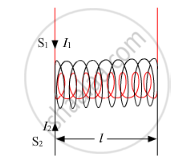
Let:
n1 = Number of turns per unit length of S1
n2 = Number of turns per unit length of S2
I1 = Current passed through solenoid S1
Φ21 = Flux linked with S2 due to current flowing through S1
Φ21 ∝ I1
Φ21 = M21I1
Where
M21 = Coefficient of mutual induction of the two solenoids
When current is passed through solenoid S1, an emf is induced in solenoid S2.
Magnetic field produced inside solenoid S1 on passing current through it is given by
B1 = μ0n1I1
Magnetic flux linked with each turn of solenoid S2 will be equal to B1 times the area of cross-section of solenoid S1
Magnetic flux linked with each turn of the solenoid S2 = B1A
Therefore, total magnetic flux linked with the solenoid S2 is given by
Φ21 = B1A × n2l = μ0n1I1 × A× n2l
Φ21 = μ0n1n2AI1
∴ M21 = μ0n1n2Al
Similarly, the mutual inductance between the two solenoids, when current is passed through solenoid S2 and induced emf is produced in solenoid S1, is given by
M12 = μ0n1n2Al
∴ M12 = M21 = M (say)
Hence, coefficient of mutual induction between the two long solenoids is given by
M = `μ (n_1n_2A)/l`
APPEARS IN
RELATED QUESTIONS
Use this law to obtain the expression for the magnetic field inside an air cored toroid of average radius 'r', having 'n' turns per unit length and carrying a steady current I.
Define the term self-inductance of a solenoid.
Draw and compare the pattern of the magnetic field lines in the two cases ?
A long solenoid is fabricated by closely winding a wire of radius 0.5 mm over a cylindrical nonmagnetic frame so that the successive turns nearly touch each other. What would be the magnetic field B at the centre of the solenoid if it carries a current of 5 A?
A copper wire having resistance 0.01 ohm in each metre is used to wind a 400-turn solenoid of radius 1.0 cm and length 20 cm. Find the emf of a battery which when connected across the solenoid will cause a magnetic field of 1.0 × 10⁻² T near the centre of the solenoid.
A tightly-wound, long solenoid is kept with its axis parallel to a large metal sheet carrying a surface current. The surface current through a width dl of the sheet is Kdl and the number of turns per unit length of the solenoid is n. The magnetic field near the centre of the solenoid is found to be zero. (a) Find the current in the solenoid. (b) If the solenoid is rotated to make its axis perpendicular to the metal sheet, what would be the magnitude of the magnetic field near its centre?
In the Ampere's Law derivation for a solenoid, why does side \(cd\) (lying outside the solenoid) contribute nothing to \(\oint \vec{B} \cdot d\vec{l}\)?
What is the magnetic field inside a long solenoid with an iron core, compared to the standard air-core expression?
Solenoid valves used in washing machines and car engines serve what function?
A solenoid has length \(l = 0.5\) m, radius \(r = 1\) cm \(= 0.01\) m, total turns \(N = 500\), and carries current \(I = 5\) A. What is the turns per unit length?
