Advertisements
Advertisements
प्रश्न
Derive an expression for the mutual inductance of two long co-axial solenoids of same length wound one over the other,
Obtain the expression for the the mutual inductance of two long co-axial solenoids S1 and S2 wound one over the other, each of length L and radii r1 and r2 and n1 and n2 number of turns per unit length, when a current I is set up in the outer solenoid S2.
Advertisements
उत्तर
Consider two long solenoids S1 and S2 of same length (l) such that solenoid S2 surrounds solenoid S1 completely.
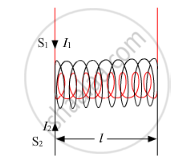
Let:
n1 = Number of turns per unit length of S1
n2 = Number of turns per unit length of S2
I1 = Current passed through solenoid S1
Φ21 = Flux linked with S2 due to current flowing through S1
Φ21 ∝ I1
Φ21 = M21I1
Where
M21 = Coefficient of mutual induction of the two solenoids
When current is passed through solenoid S1, an emf is induced in solenoid S2.
Magnetic field produced inside solenoid S1 on passing current through it is given by
B1 = μ0n1I1
Magnetic flux linked with each turn of solenoid S2 will be equal to B1 times the area of cross-section of solenoid S1
Magnetic flux linked with each turn of the solenoid S2 = B1A
Therefore, total magnetic flux linked with the solenoid S2 is given by
Φ21 = B1A × n2l = μ0n1I1 × A× n2l
Φ21 = μ0n1n2AI1
∴ M21 = μ0n1n2Al
Similarly, the mutual inductance between the two solenoids, when current is passed through solenoid S2 and induced emf is produced in solenoid S1, is given by
M12 = μ0n1n2Al
∴ M12 = M21 = M (say)
Hence, coefficient of mutual induction between the two long solenoids is given by
M = `μ (n_1n_2A)/l`
APPEARS IN
संबंधित प्रश्न
Obtain an expression for the energy stored in a solenoid of self-inductance ‘L’ when the current through it grows from zero to ‘I’.
Define the term self-inductance of a solenoid.
Obtain the expression for mutual inductance of a pair of long coaxial solenoids each of length l and radii r1 and r2 (r2 >> r1). Total number of turns in the two solenoids are N1 and N2, respectively.
A wire AB is carrying a steady current of 6 A and is lying on the table. Another wire CD carrying 4 A is held directly above AB at a height of 1 mm. Find the mass per unit length of the wire CD so that it remains suspended at its position when left free. Give the direction of the current flowing in CD with respect to that in AB. [Take the value of g = 10 ms−2]
A circular coil of one turn of radius 5.0 cm is rotated about a diameter with a constant angular speed of 80 revolutions per minute. A uniform magnetic field B = 0.010 T exists in a direction perpendicular to the axis of rotation. Suppose the ends of the coil are connected to a resistance of 100 Ω. Neglecting the resistance of the coil, find the heat produced in the circuit in one minute.
A tightly-wound, long solenoid carries a current of 2.00 A. An electron is found to execute a uniform circular motion inside the solenoid with a frequency of 1.00 × 10⁸ rev s−1. Find the number of turns per metre in the solenoid.
A current of 1.0 A is established in a tightly wound solenoid of radius 2 cm having 1000 turns/metre. Find the magnetic energy stored in each metre of the solenoid.
A long solenoid carrying a current produces a magnetic field B along its axis. If the current is doubled and the number of turns per cm is halved, the new value of magnetic field will be equal to ______.
A solenoid is defined as a long helical coil of insulated wire with many closely spaced turns. Which geometric condition must it satisfy to be classified as a 'long' solenoid?
The magnetic field inside a long solenoid is given by which of the following formulas?
