Advertisements
Advertisements
प्रश्न
Obtain the expression for the magnetic energy stored in an inductor of self-inductance L to build up a current I through it.
Advertisements
उत्तर
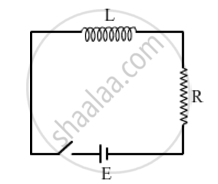
Consider the circuit shown above consisting of an inductor L and a resistor R, connected to a source of emf E. As the connections are made, the current grows in the circuit and the magnetic field increases in the inductor. Part of the work done by the battery during the process is stored in the inductor as magnetic field energy and the rest appears as thermal energy in the resistor. After sufficient time, the current, and hence the magnetic field, becomes constant and further work done by the battery appears completely as thermal energy. If i be the current in the circuit at time t, we have
`E-L(di)/dt=iR`
`=>Eidt=i^2Rdt+Lidi`
`=>int_0^tEidt=int_0^ti^2Rdt+int_0^iLidi`
`=>int_0^t Eidt=int_0^ti^2Rdt+1/2Li^2`
Now (idt) is the charge flowing through the circuit during the time t to t+dt. Thus (Eidt) is the work done by the battery in this period. The quantity on the left-hand side of the equation (i) is, therefore, the total work done by the battery in time 0 to t. Similarly, the first term on the right-hand side of equation (i) is the total thermal energy developed in the resistor at time t. Thus
`1/2Li^2`is the energy stored in the inductor as the current in it increases from 0 to i. As the energy is zero when the current is zero, the energy in an inductor carrying a current i, is `U=1/2Li^2`
APPEARS IN
संबंधित प्रश्न
Derive the expression for the magnetic field due to a solenoid of length ‘2l’, radius ‘a’ having ’n’ number of turns per unit length and carrying a steady current ‘I’ at a point
on the axial line, distance ‘r’ from the centre of the solenoid. How does this expression compare with the axial magnetic field due to a bar magnet of magnetic moment ‘m’?
Use this law to obtain the expression for the magnetic field inside an air cored toroid of average radius 'r', having 'n' turns per unit length and carrying a steady current I.
A closely wound solenoid 80 cm long has 5 layers of windings of 400 turns each. The diameter of the solenoid is 1.8 cm. If the current carried is 8.0 A, estimate the magnitude of B inside the solenoid near its centre.
A wire AB is carrying a steady current of 12 A and is lying on the table. Another wire CD carrying 5 A is held directly above AB at a height of 1 mm. Find the mass per unit length of the wire CD so that it remains suspended at its position when left free. Give the direction of the current flowing in CD with respect to that in AB. [Take the value of g = 10 ms−2]
Define mutual inductance between two long coaxial solenoids. Find out the expression for the mutual inductance of inner solenoid of length l having the radius r1 and the number of turns n1 per unit length due to the second outer solenoid of same length and r2 number of turns per unit length.
How is the magnetic field inside a given solenoid made strong?
The magnetic field inside a tightly wound, long solenoid is B = µ0 ni. It suggests that the field does not depend on the total length of the solenoid, and hence if we add more loops at the ends of a solenoid the field should not increase. Explain qualitatively why the extra-added loops do not have a considerable effect on the field inside the solenoid.
A tightly-wound, long solenoid carries a current of 2.00 A. An electron is found to execute a uniform circular motion inside the solenoid with a frequency of 1.00 × 10⁸ rev s−1. Find the number of turns per metre in the solenoid.
A current of 1.0 A is established in a tightly wound solenoid of radius 2 cm having 1000 turns/metre. Find the magnetic energy stored in each metre of the solenoid.
The length of a solenoid is 0.4 m and the number turns in it is 500. A current of 3 amp, is flowing in it. In a small coil of radius 0.01 m and number of turns 10, a current of 0.4 amp. is flowing. The torque necessary to keep the axis of this coil perpendicular to the axis of solenoid will be ______.
