Advertisements
Advertisements
प्रश्न
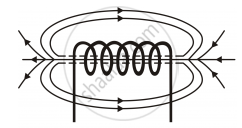
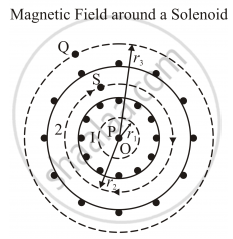
Draw and compare the pattern of the magnetic field lines in the two cases ?
Advertisements
उत्तर
Magnetic field diagrams are as followed
APPEARS IN
संबंधित प्रश्न
Obtain the expression for mutual inductance of a pair of long coaxial solenoids each of length l and radii r1 and r2 (r2 >> r1). Total number of turns in the two solenoids are N1 and N2, respectively.
Obtain the expression for the magnetic energy stored in an inductor of self-inductance L to build up a current I through it.
A wire AB is carrying a steady current of 10 A and is lying on the table. Another wire CD carrying 6 A is held directly above AB at a height of 2 mm. Find the mass per unit length of the wire CD so that it remains suspended at its position when left free. Give the direction of the current flowing in CD with respect to that in AB. [Take the value of g = 10 ms−2]
A wire AB is carrying a steady current of 6 A and is lying on the table. Another wire CD carrying 4 A is held directly above AB at a height of 1 mm. Find the mass per unit length of the wire CD so that it remains suspended at its position when left free. Give the direction of the current flowing in CD with respect to that in AB. [Take the value of g = 10 ms−2]
Define mutual inductance between two long coaxial solenoids. Find out the expression for the mutual inductance of inner solenoid of length l having the radius r1 and the number of turns n1 per unit length due to the second outer solenoid of same length and r2 number of turns per unit length.
In what respect is a toroid different from a solenoid?
The magnetic field inside a long solenoid is given by which of the following formulas?
In the Ampere's Law derivation for a solenoid, what is the contribution of the perpendicular sides \(bc\) (inside to outside) and \(da\) (outside to inside) to \(\oint \vec{B} \cdot d\vec{l}\)?
Applying Ampere's Law to the rectangular loop around a solenoid, the line integral equals \(Bl\) and the enclosed current is \(nlI\). Which sequence of steps correctly yields the magnetic field inside?
A long solenoid has \(n = 1000\) turns/m and carries a current of \(I = 5\) A. Taking \(\mu_0 = 4\pi \times 10^{-7}\), what is the magnetic field inside the solenoid?
