Advertisements
Advertisements
प्रश्न
Obtain the expression for mutual inductance of a pair of long coaxial solenoids each of length l and radii r1 and r2 (r2 >> r1). Total number of turns in the two solenoids are N1 and N2, respectively.
Advertisements
उत्तर
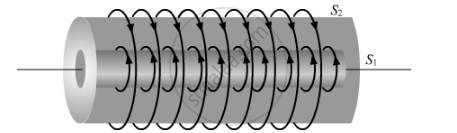
Suppose a current i is passed through the inner solenoid S1.
A magnetic field B=μ0n1i is produced inside S1 , whereas the field outside it is zero.
The flux through each turn S2 is Bπr12=μ0n1iπr12
The total flux through all the turns in a length l of S2 is
ϕ=(μ0n1iπr12)n2l=(μ0n1n2πr12l)i
⇒M=μ0n1n2πr12l
APPEARS IN
संबंधित प्रश्न
Obtain an expression for the energy stored in a solenoid of self-inductance ‘L’ when the current through it grows from zero to ‘I’.
Derive the expression for the magnetic field due to a solenoid of length ‘2l’, radius ‘a’ having ’n’ number of turns per unit length and carrying a steady current ‘I’ at a point
on the axial line, distance ‘r’ from the centre of the solenoid. How does this expression compare with the axial magnetic field due to a bar magnet of magnetic moment ‘m’?
Obtain the expression for the magnetic energy stored in an inductor of self-inductance L to build up a current I through it.
The magnetic field inside a tightly wound, long solenoid is B = µ0 ni. It suggests that the field does not depend on the total length of the solenoid, and hence if we add more loops at the ends of a solenoid the field should not increase. Explain qualitatively why the extra-added loops do not have a considerable effect on the field inside the solenoid.
A long solenoid of radius 2 cm has 100 turns/cm and carries a current of 5 A. A coil of radius 1 cm having 100 turns and a total resistance of 20 Ω is placed inside the solenoid coaxially. The coil is connected to a galvanometer. If the current in the solenoid is reversed in direction, find the charge flown through the galvanometer.
A circular coil of one turn of radius 5.0 cm is rotated about a diameter with a constant angular speed of 80 revolutions per minute. A uniform magnetic field B = 0.010 T exists in a direction perpendicular to the axis of rotation. Suppose the ends of the coil are connected to a resistance of 100 Ω. Neglecting the resistance of the coil, find the heat produced in the circuit in one minute.
Applying Ampere's Law to the rectangular loop around a solenoid, the line integral equals \(Bl\) and the enclosed current is \(nlI\). Which sequence of steps correctly yields the magnetic field inside?
What is the magnetic field at the ends (edge) of a long solenoid carrying current \(I\)?
Which statement about the ends of a solenoid versus a toroid is correct?
