Advertisements
Advertisements
Question
Two polaroids P1 and P2 are placed with their pass axes perpendicular to each other. An unpolarised light of intensity Io is incident on P1. A third polaroid P3 is kept in between P1 and P2 such that its pass axis makes an angle of 45° with that of P1. Determine the intensity of light transmitted through P1, P2 and P3
Advertisements
Solution
As given in the question, the polaroids P1 and P2 are placed with their pass axes perpendicular to each other. Also, P3 is placed at an angle of 45° with respect to P1.
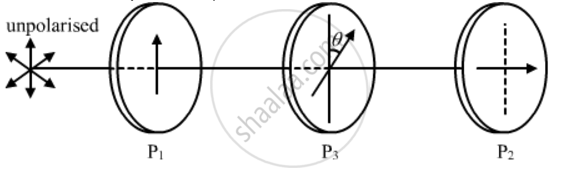
Now, we have:
Intensity of light after falling on P1 `I'=I_0/2`
Intensity of light after falling on P3 I"=
`I'cos^2(theta)=I_0/2cos^2(45^@)=I_0/4`
Therefore, a light of intensity `I_0/4`will pass through P3 and the angle between P3 and P2 will be 45° because of the condition given in the question.
Intensity of light after falling on P2 I''' = I'' `cos^2(theta)=I_0/4cos^2(45^@)=I_0/8`
APPEARS IN
RELATED QUESTIONS
What is a Polaroid?
What dose a polaroid consist of?
Using the phenomenon of polarisation, show how the transverse nature of light can be demonstrated.
The refractive indices of water for red and violet colours are 1.325 and 1.334 respectively.
Find the difference between the velocities of rays for these two colours in water. (c = 3 × 10⁸ m/s)
Discuss polarisation by selective absorption.
List the uses of polaroids.
What is the angle of polarisation and obtain the equation for an angle of polarisation?
What is double refraction?
How is polarisation of light obtained by scattering of light?
Figure shown a two slit arrangement with a source which emits unpolarised light. P is a polariser with axis whose direction is not given. If I0 is the intensity of the principal maxima when no polariser is present, calculate in the present case, the intensity of the principal maxima as well as of the first minima.

