Advertisements
Advertisements
प्रश्न
Two polaroids P1 and P2 are placed with their pass axes perpendicular to each other. An unpolarised light of intensity Io is incident on P1. A third polaroid P3 is kept in between P1 and P2 such that its pass axis makes an angle of 45° with that of P1. Determine the intensity of light transmitted through P1, P2 and P3
Advertisements
उत्तर
As given in the question, the polaroids P1 and P2 are placed with their pass axes perpendicular to each other. Also, P3 is placed at an angle of 45° with respect to P1.
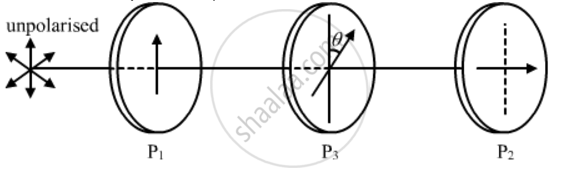
Now, we have:
Intensity of light after falling on P1 `I'=I_0/2`
Intensity of light after falling on P3 I"=
`I'cos^2(theta)=I_0/2cos^2(45^@)=I_0/4`
Therefore, a light of intensity `I_0/4`will pass through P3 and the angle between P3 and P2 will be 45° because of the condition given in the question.
Intensity of light after falling on P2 I''' = I'' `cos^2(theta)=I_0/4cos^2(45^@)=I_0/8`
APPEARS IN
संबंधित प्रश्न
If the polarising angle for a given medium is 60°, then the refractive index of the medium is.................
Why does an unpolarised light incident on a polaroid get linearly polarised ?
Show, with the help of a diagram, how unpolarised sunlight gets polarised due to scattering.
Using the phenomenon of polarisation, show how the transverse nature of light can be demonstrated.
The refractive indices of water for red and violet colours are 1.325 and 1.334 respectively.
Find the difference between the velocities of rays for these two colours in water. (c = 3 × 10⁸ m/s)
The glass plate of refractive index 1.732 is to be used as a polarizer, its polarising angle is _______.
Show using a proper diagram how unpolarised light can be linearly polarised by reflection from a transparent glass surface.
State and obtain Malus’ law.
Can reflection result in plane polarised light if the light is incident on the interface from the side with higher refractive index?
To ensure almost 100 per cent transmissivity, photographic lenses are often coated with a thin layer of dielectric material. The refractive index of this material is intermediated between that of air and glass (which makes the optical element of the lens). A typically used dielectric film is MgF2 (n = 1.38). What should the thickness of the film be so that at the center of the visible spectrum (5500 Å) there is maximum transmission.
