मराठी

A Resistance of R Ω Draws Current from a Potentiometer as Shown in the Figure. the Potentiometer Has a Total Resistance Ro ω. a Voltage V is Supplied to the Potentiometer. Derive an Expression for the Voltage Across R When the Sliding Contact is in the Middle of the Potentiometer. - Physics

Advertisements
Advertisements

प्रश्न

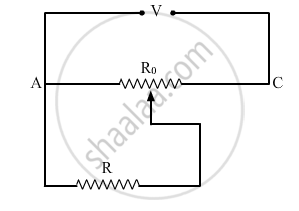
A resistance of R Ω draws current from a potentiometer as shown in the figure. The potentiometer has a total resistance Ro Ω. A voltage V is supplied to the potentiometer. Derive an expression for the voltage across R when the sliding contact is in the middle of the potentiometer.
Advertisements

उत्तर

From the figure given in the question, current I through Ro is 

`I=V/R_o`

Now, the sliding contact is in the middle of the wire. From the relation `R=rhol/A`

∝ l (where ρ and A are constants)

where l is the length of the wire, ρ is the resistivity and A is the area of the wire.

Resistance of half of the wire of the potentiometer is 

`R'=R_o/2`

Now R' and R are in parallel; therefore, voltage across R and R' is equal. Therefore, voltage across R is

`:.V'=I.R'=V/R_o"."R_o/2`

 `=>V'=V/2`

shaalaa.com
  या प्रश्नात किंवा उत्तरात काही त्रुटी आहे का?
2013-2014 (March) All India Set 2

व्हिडिओ ट्यूटोरियलVIEW ALL [3]

संबंधित प्रश्‍न

In potentiometer experiment, if l1 is the balancing length for e.m.f. of cell of internal resistance r and l2 is the balancing length for its terminal potential difference when shunted with resistance R then :


Why are the connections between the resistors in a meter bridge made of thick copper strips?


Why is it generally preferred to obtain the balance point in the middle of the meter bridge wire?


(a) In a metre bridge [shown in the figure], the balance point is found to be at 39.5 cm from the end A, when the resistor Y is 12.5 Ω. Determine the resistance of X. Why are the connections between resistors in a Wheatstone or meter bridge made of thick copper strips?

(b) Determine the balance point of the bridge above if X and Y are interchanged.

(c) What happens if the galvanometer and cell are interchanged at the balance point of the bridge? Would the galvanometer show any current?


When a resistance of 12 ohm is connected across a cell, its terminal potential difference is balanced by 120 cm length of potentiometer wire. When the resistance of 18 ohm is connected across the same cell, the balancing length is 150 cm. Find the balancing length when the cell is in open circuit. Also calculate the internal resistance of the cell.


In a metre bridge, the balance point is found at a distance l1 with resistances R and S as shown in the figure.An unknown resistance X is now connected in parallel to the resistance S and the balance point is found at a distance l2. Obtain a formula for X in terms of l1, l2 and S. 


The figure shows experimental set up of a meter bridge. When the two unknown resistances X and Y are inserted, the null point D is obtained 40 cm from the end A. When a resistance of 10 Ω is connected in series with X, the null point shifts by 10 cm. Find the position of the null point when the 10 Ω resistance is instead connected in series with resistance ‘Y’. Determine the values of the resistances X and Y.


In meter bridge or Wheatstone bridge for measurement of resistance, the known and the unknown resistance are interchanged. The error so removed is ______.

In a meter bridge experiment, resistance are connected as shown in figure, The balancing length 1, is 55 cm. Now an unknown resistance x is connected in series with P and new balancing length is found to be 75cm. The value of x is ______.


In a sensitive meter bridge apparatus the bridge wire should possess ______.


Share
Notifications

Englishहिंदीमराठी


      Forgot password?
Use app×