Advertisements
Advertisements
Question
A capacitor of capacitance 100 µF is connected to a battery of 20 volts for a long time and then disconnected from it. It is now connected across a long solenoid having 4000 turns per metre. It is found that the potential difference across the capacitor drops to 90% of its maximum value in 2.0 seconds. Estimate the average magnetic field produced at the centre of the solenoid during this period.
Advertisements
Solution
Given:
Capacitance, C = 100 microfarad
Voltage, V = 20 V
Charge stored in the capacitor, Q = CV
\[= 100 \times {10}^{- 6} \times 20\]
\[ = 2 \times {10}^{- 3} C\]
It is given that the potential difference across the capacitor drops to 90% of its maximum value.
Thus,
\[V' = \frac{90}{100} \times 20 = 18 V\]
\[\text{ New charge, }Q' = CV' = 1 . 8 \times {10}^{- 3} C\]
\[\text{ Now, }\]
\[\text{ Current, i }= \frac{Q - Q'}{t}\]
\[ \Rightarrow i = \frac{(2 - 1 . 8) \times {10}^{- 3}}{2} = \frac{2 \times {10}^{- 4}}{2}\]
\[ \Rightarrow i = 1 \times {10}^{- 4} A\]
No. of turns per metre, n = 4000
Thus, the average magnetic field at the centre of the solenoid is given by
\[B = \mu_0 ni\]
\[ = 4\pi \times {10}^{- 7} \times 4000 \times {10}^{- 4} \]
\[ = 16\pi \times {10}^{- 8} \]T
APPEARS IN
RELATED QUESTIONS
Obtain an expression for the energy stored in a solenoid of self-inductance ‘L’ when the current through it grows from zero to ‘I’.
An observer to the left of a solenoid of N turns each of cross section area 'A' observes that a steady current I in it flows in the clockwise direction. Depict the magnetic field lines due to the solenoid specifying its polarity and show that it acts as a bar magnet of magnetic moment m = NIA.
Derive an expression for the mutual inductance of two long co-axial solenoids of same length wound one over the other,
Two long coaxial insulated solenoids, S1 and S2 of equal lengths are wound one over the other as shown in the figure. A steady current "I" flow thought the inner solenoid S1 to the other end B, which is connected to the outer solenoid S2 through which the same current "I" flows in the opposite direction so as to come out at end A. If n1 and n2 are the number of turns per unit length, find the magnitude and direction of the net magnetic field at a point (i) inside on the axis and (ii) outside the combined system
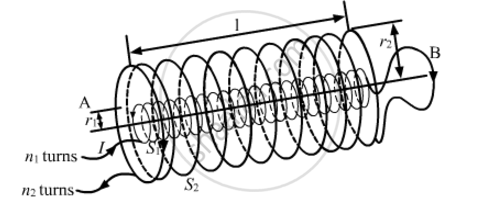
Obtain the expression for mutual inductance of a pair of long coaxial solenoids each of length l and radii r1 and r2 (r2 >> r1). Total number of turns in the two solenoids are N1 and N2, respectively.
A closely wound solenoid 80 cm long has 5 layers of windings of 400 turns each. The diameter of the solenoid is 1.8 cm. If the current carried is 8.0 A, estimate the magnitude of B inside the solenoid near its centre.
Define self-inductance of a coil.
Obtain the expression for the magnetic energy stored in an inductor of self-inductance L to build up a current I through it.
A wire AB is carrying a steady current of 10 A and is lying on the table. Another wire CD carrying 6 A is held directly above AB at a height of 2 mm. Find the mass per unit length of the wire CD so that it remains suspended at its position when left free. Give the direction of the current flowing in CD with respect to that in AB. [Take the value of g = 10 ms−2]
Draw and compare the pattern of the magnetic field lines in the two cases ?
A long solenoid of radius 2 cm has 100 turns/cm and carries a current of 5 A. A coil of radius 1 cm having 100 turns and a total resistance of 20 Ω is placed inside the solenoid coaxially. The coil is connected to a galvanometer. If the current in the solenoid is reversed in direction, find the charge flown through the galvanometer.
The magnetic field B inside a long solenoid, carrying a current of 5.00 A, is 3.14 × 10⁻² T. Find the number of turns per unit length of the solenoid.
A long solenoid is fabricated by closely winding a wire of radius 0.5 mm over a cylindrical nonmagnetic frame so that the successive turns nearly touch each other. What would be the magnetic field B at the centre of the solenoid if it carries a current of 5 A?
A long solenoid carrying a current produces a magnetic field B along its axis. If the current is doubled and the number of turns per cm is halved, the new value of magnetic field will be equal to ______.
The net effect of a current-carrying solenoid is that it behaves like a bar magnet whose polarity is determined by which rule?
In the Ampere's Law derivation for a solenoid, why does side \(cd\) (lying outside the solenoid) contribute nothing to \(\oint \vec{B} \cdot d\vec{l}\)?
Which statement about the ends of a solenoid versus a toroid is correct?
