Please select a subject first
Advertisements
Advertisements
A semiconductor device is connected in series with a battery, an ammeter and a resistor. A current flows in the circuit. If. the polarity of the battery is reversed, the current in the circuit almost becomes zero. The device is a/an ______.
Concept: Semiconductor Diode
With the help of a circuit diagram, explain how a full wave rectifier gives output rectified voltage corresponding to both halves of the input ac voltage.
Concept: Application of Junction Diode as a Rectifier
- Assertion (A): The resistance of an intrinsic semiconductor decreases with an increase in its temperature.
- Reason (R): The number of conduction electrons as well as hole increase in an intrinsic semiconductor with the rise in its temperature.
Concept: Intrinsic Semiconductor
- Assertion (A): In insulators, the forbidden gap is very large.
- Reason (R): The valence electrons in an atom of an insulator are very tightly bound to the nucleus.
Concept: Energy Bands in Conductors, Semiconductors and Insulators
The energy required by an electron to jump the forbidden band in silicon at room temperature is about ______.
Concept: Energy Bands in Conductors, Semiconductors and Insulators
Which one of the following elements will require the highest energy to take out an electron from them?
Pb, Ge, C and Si
Concept: Energy Bands in Conductors, Semiconductors and Insulators
- Assertion (A): Putting the p-type semiconductor slab directly in physical contact with the n-type semiconductor slab cannot form the pn junction.
- Reason (R): The roughness at contact will be much more than inter atomic crystal spacing and continuous flow of charge carriers is not possible.
Concept: Extrinsic Semiconductor
Name the device which utilizes the unilateral action of a pn diode to convert ac into dc.
Concept: Application of Junction Diode as a Rectifier
Read the following paragraph and answer the questions that follow.
| A semiconductor diode is basically a pn junction with metallic contacts provided at the ends for the application of an external voltage. It is a two-terminal device. When an external voltage is applied across a semiconductor diode such that the p-side is connected to the positive terminal of the battery and the n-side to the negative terminal, it is said to be forward-biased. When an external voltage is applied across the diode such that the n-side is positive and the p-side is negative, it is said to be reverse-biased. An ideal diode is one whose resistance in forward biasing is zero and the resistance is infinite in reverse biasing. When the diode is forward biased, it is found that beyond forward voltage called knee voltage, the conductivity is very high. When the biasing voltage is more than the knee voltage the potential barrier is overcome and the current increases rapidly with an increase in forward voltage. When the diode is reverse biased, the reverse bias voltage produces a very small current of about a few microamperes which almost remains constant with bias. This small current is a reverse saturation current. |
- In the given figure, a diode D is connected to an external resistance R = 100 Ω and an emf of 3.5 V. If the barrier potential developed across the diode is 0.5 V, the current in the circuit will be:
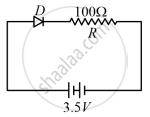
(a) 40 mA
(b) 20 mA
(c) 35 mA
(d) 30 mA - In which of the following figures, the pn diode is reverse biased?
(a)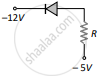
(b)
(c)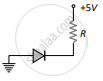
(d)
- Based on the V-I characteristics of the diode, we can classify the diode as:
(a) bilateral device
(b) ohmic device
(c) non-ohmic device
(d) passive element
OR
Two identical PN junctions can be connected in series by three different methods as shown in the figure. If the potential difference in the junctions is the same, then the correct connections will be:
(a) in the circuits (1) and (2)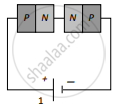

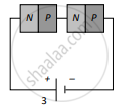
(b) in the circuits (2) and (3)
(c) in the circuits (1) and (3)
(d) only in the circuit (1) 
The V-I characteristic of a diode is shown in the figure. The ratio of the resistance of the diode at I = 15 mA to the resistance at V = -10 V is
(a) 100
(b) 106
(c) 10
(d) 10-6
Concept: Semiconductor Diode
A signal of 5 kHz frequency is amplitude modulated on a carrier wave of frequency 2 MHz. What are the frequencies of the side bands produced?
Concept: Amplitude Modulation (AM)
Why is base band signal not transmitted directly? Give any two reasons
Concept: Need for Modulation and Demodulation
State three important factors showing the need for translating a low frequency signal into a high frequency wave before transmission
Concept: Modulation and Its Necessity
Draw a sketch of a sinusoidal carrier wave along with a modulating signal and show how these are superimposed to obtain the resultant amplitude modulated wave
Concept: Modulation and Its Necessity
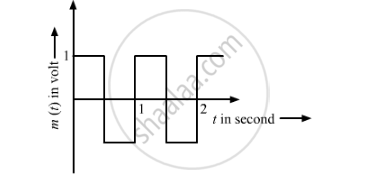
The carrier wave is given by
C(t) = 2sin(8πt) volt.
The modulating signal is a square wave as shown. Find modulation index.
Concept: Modulation and Its Necessity
Write the functions of the following in communication systems:
Modulator
Concept: Basic Terminology Used in Electronic Communication Systems
Write the functions of the following in communication systems:
Transducer
Concept: Basic Terminology Used in Electronic Communication Systems
Write the functions of the following in communication systems:
Demodulator
Concept: Basic Terminology Used in Electronic Communication Systems
Why is Modulation index kept low?
Concept: Modulation and Its Necessity
What is the role of a bandpass filter?
Concept: Modulation and Its Necessity
Distinguish between broadcast mode and point-to-point mode of communication and give one example for each.
Concept: Basic Terminology Used in Electronic Communication Systems
