Advertisements
Advertisements
Question
A signal of 5 kHz frequency is amplitude modulated on a carrier wave of frequency 2 MHz. What are the frequencies of the side bands produced?
Advertisements
Solution
The frequencies of the side bands produced are
Maximum frequency: 5 kHz + 2 MHz
=5 x 10⁻³ MHz + 2 MHz
=0.005 + 2 = 2.005 MHz
APPEARS IN
RELATED QUESTIONS
Explain any two factors that justify the need of modulating a low-frequency signal.
A modulating signal is a square wave, as shown
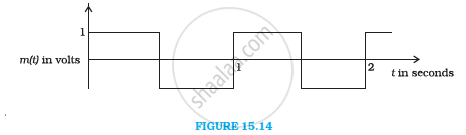
The carrier wave is given by `c(t) = 2 sin (8pit) "volts"`
(i) Sketch the amplitude modulated waveform
(ii) What is the modulation index?
Define the term 'amplitude modulation'
Draw a schematic sketch showing how amplitude modulated signal is obtained by superposing a modulating signal over a sinusoidal carrier wave.
Solve the following question.
A message signal of frequency 20 kHz and peak voltage 10 V is used to modulate a carrier of frequency 2 MHz and peak voltage of 15 V. Calculate the modulation index. Why the modulation index is generally kept less than one?
The maximum amplitude of an A.M. wave is found to be 15 V while its minimum amplitude is found to be 3 V. What is the modulation index?
Compute the LC product of a tuned amplifier circuit required to generate a carrier wave of 1 MHz for amplitude modulation.
An amplitude modulated wave is as shown in figure. Calculate
- the percentage modulation
- peak carrier voltage and
- peak value of information voltage.

An amplitude-modulated wave is represented by Cm(t) = 10(1 + 0.2 cos 12560t) × sin (111 × 104t) volts. The modulating frequency in kHz will be ______.
A signal of 5 kHz frequency is amplitude modulated on a carrier wave of frequency 2 MHz. The frequencies of the resultant signal are ______.
