Advertisements
Advertisements
Question
A message signal of frequency ωm is superposed on a carrier wave of frequency ωc to get an amplitude modulated wave (AM). The frequency of the AM wave will be ______.
Options
ωm
ωc
`(ω_"c" + ω_"m")/2`
`(ω_"c" - ω_"m")/2`
Advertisements
Solution
A message signal of frequency ωm is superposed on a carrier wave of frequency ωc to get an amplitude modulated wave (AM). The frequency of the AM wave will be ωc.
Explanation:
The process of changing the amplitude of a carrier wave in accordance with the amplitude of the audio frequency (AF) signal is known as amplitude modulation (AM).
In AM, the frequency of the carrier wave remains unchanged or we can say that the frequency of a modulated wave is equal to the frequency of the carrier wave. Now, according to the problem, the frequency of the carrier wave is fc.
Thus the amplitude modulated wave also has frequency fc.
APPEARS IN
RELATED QUESTIONS
A signal of 5 kHz frequency is amplitude modulated on a carrier wave of frequency 2 MHz. What are the frequencies of the side bands produced?
Draw a block diagram of a detector for AM signal and show, using necessary processes and the waveforms, how the original message signal is detected from the input AM wave.
A modulating signal is a square wave, as shown
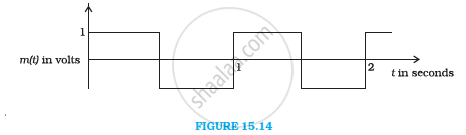
The carrier wave is given by `c(t) = 2 sin (8pit) "volts"`
(i) Sketch the amplitude modulated waveform
(ii) What is the modulation index?
For an amplitude modulated wave, the maximum amplitude is found to be 10 V while the minimum amplitude is found to be 2 V. Determine the modulation index μ. What would be the value of μ if the minimum amplitude is zero volt?
How is amplitude modulation achieved?
Write two advantages of frequency modulation over amplitude modulation.
Write three important factors which justify the need of modulating a message signal. Show diagrammatically how an amplitude modulated wave is obtained when a modulating signal is superimposed on a carrier wave.
Solve the following question.
A message signal of frequency 20 kHz and peak voltage 10 V is used to modulate a carrier of frequency 2 MHz and peak voltage of 15 V. Calculate the modulation index. Why the modulation index is generally kept less than one?
In amplitude modulation, the modulation index m, is kept less than or equal to 1 because ______.
- m > 1, will result in interference between carrier frequency and message frequency, resulting into distortion.
- m > 1 will result in overlapping of both side bands resulting into loss of information.
- m > 1 will result in change in phase between carrier signal and message signal.
- m > 1 indicates amplitude of message signal greater than amplitude of carrier signal resulting into distortion.
Compute the LC product of a tuned amplifier circuit required to generate a carrier wave of 1 MHz for amplitude modulation.
On radiating (sending out) an AM modulated signal, the total radiated power is due to energy carried by ωc, ωc – ωm and ωc + ωm. Suggest ways to minimise cost of radiation without compromising on information.
An amplitude modulated wave is as shown in figure. Calculate
- the percentage modulation
- peak carrier voltage and
- peak value of information voltage.

An audio signal vm = 20sin2π(1500t) amplitude modulates a carrier vc = 80 sin 2π (100,000t). The value of percent modulation is ______.
The maximum and minimum voltage of an amplitude modulated signal are 60 V and 20 V respectively. The percentage modulation index will be ______.
