Advertisements
Advertisements
Question
Compute the LC product of a tuned amplifier circuit required to generate a carrier wave of 1 MHz for amplitude modulation.
Advertisements
Solution
Frequency of tuned amplifier is `v = 1/(2pisqrt(LC))`
As per question, `v = 1 MHz = 10^6 Hz`
or `10^6 = 1/(2pisqrt(LC))`
or LC = `1/(4pi^2 (10^6)^2` = 2.5 × 10⁻¹⁴s
APPEARS IN
RELATED QUESTIONS
Explain any two factors that justify the need of modulating a low-frequency signal.
A signal of 5 kHz frequency is amplitude modulated on a carrier wave of frequency 2 MHz. What are the frequencies of the side bands produced?
A modulating signal is a square wave, as shown
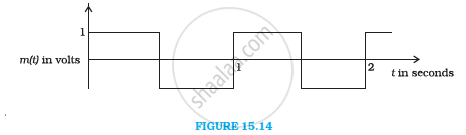
The carrier wave is given by `c(t) = 2 sin (8pit) "volts"`
(i) Sketch the amplitude modulated waveform
(ii) What is the modulation index?
For an amplitude modulated wave, the maximum amplitude is found to be 10 V while the minimum amplitude is found to be 2 V. Determine the modulation index μ. What would be the value of μ if the minimum amplitude is zero volt?
How is amplitude modulation achieved?
Define the term 'amplitude modulation'
Explain any two factors which justify the need for modulating a low frequency base-band signal.
Write two advantages of frequency modulation over amplitude modulation.
What is meant by term ‘modulation’? Draw a block diagram of a simple modulator for obtaining an AM signal.
Answer the following question.
If A and B represent the maximum and minimum amplitudes of an amplitude-modulated wave, write the expression for the modulation index in terms of A and B.
Solve the following question.
A message signal of frequency 20 kHz and peak voltage 10 V is used to modulate a carrier of frequency 2 MHz and peak voltage of 15 V. Calculate the modulation index. Why the modulation index is generally kept less than one?
Define amplitude modulation in a communication system.
A message signal of frequency ωm is superposed on a carrier wave of frequency ωc to get an amplitude modulated wave (AM). The frequency of the AM wave will be ______.
In amplitude modulation, the modulation index m, is kept less than or equal to 1 because ______.
- m > 1, will result in interference between carrier frequency and message frequency, resulting into distortion.
- m > 1 will result in overlapping of both side bands resulting into loss of information.
- m > 1 will result in change in phase between carrier signal and message signal.
- m > 1 indicates amplitude of message signal greater than amplitude of carrier signal resulting into distortion.
Why is a AM signal likely to be more noisy than a FM signal upon transmission through a channel?
An amplitude modulated wave is as shown in figure. Calculate
- the percentage modulation
- peak carrier voltage and
- peak value of information voltage.

Draw the plot of amplitude versus ‘ω’ for an amplitude modulated wave whose carrier wave (ωc) is carrying two modulating signals, ω1 and ω2 (ω2 > ω1).
- Is the plot symmetrical about ωc? Comment especially about plot in region ω < ωc.
- Extrapolate and predict the problems one can expect if more waves are to be modulated.
- Suggest solutions to the above problem. In the process can one understand another advantage of modulation in terms of bandwidth?
An audio signal vm = 20sin2π(1500t) amplitude modulates a carrier vc = 80 sin 2π (100,000t). The value of percent modulation is ______.
A signal of 5 kHz frequency is amplitude modulated on a carrier wave of frequency 2 MHz. The frequencies of the resultant signal are ______.
