Advertisements
Advertisements
Question
Draw a block diagram of a detector for AM signal and show, using necessary processes and the waveforms, how the original message signal is detected from the input AM wave.
Advertisements
Solution

When a message is received, it gets attenuated through the channel. Therefore, receiving antenna is to be followed by an amplifier and a detector. The carrier frequency is usually changed to a lower frequency in an intermediate frequency (IF) stage. The detected signal may not be strong enough to be made use of and, hence, is required to be amplified.
In order to obtain the original message signal m(t) of angular frequency, a simple method is used which is shown below in the form of a block diagram.

When the received modulated signal is passed through a rectifier, an envelope signal is produced. This envelope signal is the message signal. In order to retrieve the message, the signal is passed through an envelope detector.
APPEARS IN
RELATED QUESTIONS
Explain any two factors that justify the need of modulating a low-frequency signal.
A modulating signal is a square wave, as shown
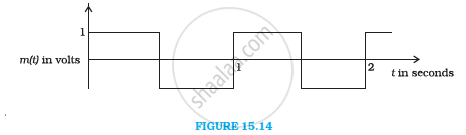
The carrier wave is given by `c(t) = 2 sin (8pit) "volts"`
(i) Sketch the amplitude modulated waveform
(ii) What is the modulation index?
Write two advantages of frequency modulation over amplitude modulation.
What is meant by term ‘modulation’? Draw a block diagram of a simple modulator for obtaining an AM signal.
Solve the following question.
A message signal of frequency 20 kHz and peak voltage 10 V is used to modulate a carrier of frequency 2 MHz and peak voltage of 15 V. Calculate the modulation index. Why the modulation index is generally kept less than one?
In amplitude modulation ______.
A message signal of frequency ωm is superposed on a carrier wave of frequency ωc to get an amplitude modulated wave (AM). The frequency of the AM wave will be ______.
Identify the mathematical expression for amplitude modulated wave ______.
On radiating (sending out) an AM modulated signal, the total radiated power is due to energy carried by ωc, ωc – ωm and ωc + ωm. Suggest ways to minimise cost of radiation without compromising on information.
An amplitude-modulated wave is represented by Cm(t) = 10(1 + 0.2 cos 12560t) × sin (111 × 104t) volts. The modulating frequency in kHz will be ______.
