Advertisements
Advertisements
Question
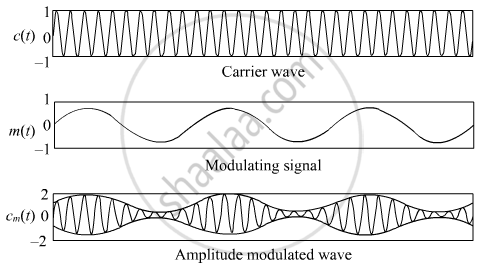
Write three important factors which justify the need of modulating a message signal. Show diagrammatically how an amplitude modulated wave is obtained when a modulating signal is superimposed on a carrier wave.
Advertisements
Solution
Three important factors which justify the need of modulating a message signal:
(i) Size of antenna or aerial: For communication within the effective length of the antennas, the transmitting frequencies should be high, so modulation is required.
(ii) Effective power which is radiated by antenna: Since the power radiated from a linear antenna is inversely proportional to the square of the transmitting wavelength. As high powers are needed for good transmission so, higher frequency is required which can be achieved by modulation.
(iii) The interference of signals from different transmitters: To avoid the interference of the signals there is need of high frequency which can be achieved by the modulation.
RELATED QUESTIONS
A signal of 5 kHz frequency is amplitude modulated on a carrier wave of frequency 2 MHz. What are the frequencies of the side bands produced?
Explain the process of amplitude modulation.
How is amplitude modulation achieved?
Write two advantages of frequency modulation over amplitude modulation.
What is meant by term ‘modulation’? Draw a block diagram of a simple modulator for obtaining an AM signal.
Define amplitude modulation in a communication system.
A message signal of frequency ωm is superposed on a carrier wave of frequency ωc to get an amplitude modulated wave (AM). The frequency of the AM wave will be ______.
In amplitude modulation, the modulation index m, is kept less than or equal to 1 because ______.
- m > 1, will result in interference between carrier frequency and message frequency, resulting into distortion.
- m > 1 will result in overlapping of both side bands resulting into loss of information.
- m > 1 will result in change in phase between carrier signal and message signal.
- m > 1 indicates amplitude of message signal greater than amplitude of carrier signal resulting into distortion.
On radiating (sending out) an AM modulated signal, the total radiated power is due to energy carried by ωc, ωc – ωm and ωc + ωm. Suggest ways to minimise cost of radiation without compromising on information.
The maximum amplitude for an amplitude modulated wave is found to be 12V while the minimum amplitude is found to be 3V. The modulation index is 0.6x where x is ______.
