Advertisements
Advertisements
प्रश्न
A signal of 5 kHz frequency is amplitude modulated on a carrier wave of frequency 2 MHz. What are the frequencies of the side bands produced?
Advertisements
उत्तर
The frequencies of the side bands produced are
Maximum frequency: 5 kHz + 2 MHz
=5 x 10⁻³ MHz + 2 MHz
=0.005 + 2 = 2.005 MHz
APPEARS IN
संबंधित प्रश्न
Explain the process of amplitude modulation.
A modulating signal is a square wave, as shown
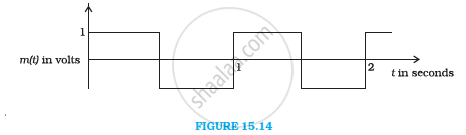
The carrier wave is given by `c(t) = 2 sin (8pit) "volts"`
(i) Sketch the amplitude modulated waveform
(ii) What is the modulation index?
Define the term 'amplitude modulation'
Draw a schematic sketch showing how amplitude modulated signal is obtained by superposing a modulating signal over a sinusoidal carrier wave.
Write two advantages of frequency modulation over amplitude modulation.
In amplitude modulation ______.
Identify the mathematical expression for amplitude modulated wave ______.
Why is a AM signal likely to be more noisy than a FM signal upon transmission through a channel?
The maximum and minimum voltage of an amplitude modulated signal are 60 V and 20 V respectively. The percentage modulation index will be ______.
The maximum amplitude for an amplitude modulated wave is found to be 12V while the minimum amplitude is found to be 3V. The modulation index is 0.6x where x is ______.
