Advertisements
Advertisements
प्रश्न
Draw the plot of amplitude versus ‘ω’ for an amplitude modulated wave whose carrier wave (ωc) is carrying two modulating signals, ω1 and ω2 (ω2 > ω1).
- Is the plot symmetrical about ωc? Comment especially about plot in region ω < ωc.
- Extrapolate and predict the problems one can expect if more waves are to be modulated.
- Suggest solutions to the above problem. In the process can one understand another advantage of modulation in terms of bandwidth?
Advertisements
उत्तर
`v(t) = A(A_(m_1) sin ω_(m_1) t + A_(m_2) sinω_(m_2) t + A_c sin ω_c t) + B(A_(m_1) sin ω_(m_1) t + A_(m_2) t + A_c sinω_ct)^2`
= `A(A_(m_1) sin ω_(m_1) t + A_(m_2) sin ω_(m_2) t + A_c sin ω_ct)^2 + B((A_(m_1) sin ω_(m_1) t + A_(m_2) t)^2 + A_c^2 sin^2 ω_ct + 2A_c (A_(m_1) sinω_(m_1) t + A_(m_2) sin ω_c t)`
= `A(A_1 sin ω_(m_1) t + A_(m_2) sin ω_(m_2) t + A_c sin ω_ct) + B[A_(m_1^2) sin^2 ω_(m_1) t + A_(m_2)^2 sin^2 ω_(m_2)t + 2A_(m_1) A_(m_2) sin ω_(m_1) t sin ω_(m_2)t + A_c^2 sin^2 ω_ct + 2A_c (A_(m_1) sin ω_(m_1) t sin ω_ct + A_(m_2) sin ω_(m_2) + sin ω_ct]`
= `A(A_(m_1) sin ω_(m_1) t + A_(m_2) sin ω_(m_2) t + A_c sin ω_c t + B[A_(m_1)^2 sin^2 ω_(m_1) t + A_(m_2)^2 sin^2 ω_(m_2) t + A_c^2 sin^2 ω_c t + (2A_(m_1) A_(m_2))/2 [cos (ω_(m_2) - ω_(m_1))t - cos(ω_(m_1) + ω_(n_2))t] + (2A_c A_(m_2))/2 [cos(ω_c - ω_(m_1))t - cos[ω_c + ω_(m_1))t + (2A_cA_(m_1))/2 [cos(ω_c - ω_(m_2))t - cos(ω_c + ω_(m_2))t]]`
∴ Frequencies present are `ω_(m_1), ω_(m_2), ω_(ω_c)`
`(ω_(m_1) - ω_(m_1)), (ω_(m_1) + ω_(m_2))`
`(ω_c - ω_(m_1)), (ω_c + ω_(m_1))`
`(ω_c - ω_(m_2)), (ω_c + ω_(m_2))`
i. Plot of amplitude versus ω is shown in the Figure.
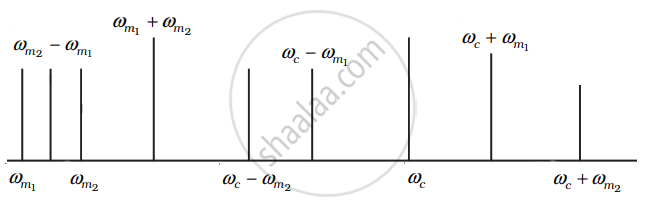
ii. As can be seen frequency spectrum is not symmetrical about ωc. Crowding of the spectrum is present for ω < ωc.
iii. Adding more modulating signals lead to more crowding in ω < ωc and more chances of mixing of signals.
iv. Increase bandwidth and ωc to accommodate more signals. This shows that a large carrier frequency enables to carry more information (more ωm) and which will in turn increase bandwidth.
APPEARS IN
संबंधित प्रश्न
Draw a block diagram of a detector for AM signal and show, using necessary processes and the waveforms, how the original message signal is detected from the input AM wave.
Explain the process of amplitude modulation.
A modulating signal is a square wave, as shown
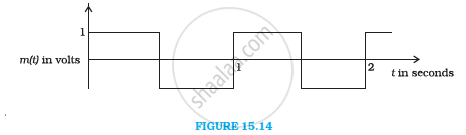
The carrier wave is given by `c(t) = 2 sin (8pit) "volts"`
(i) Sketch the amplitude modulated waveform
(ii) What is the modulation index?
Define the term 'amplitude modulation'
Write two advantages of frequency modulation over amplitude modulation.
What is meant by term ‘modulation’? Draw a block diagram of a simple modulator for obtaining an AM signal.
Why is frequency modulation preferred over amplitude modulation for transmission of music?
Solve the following question.
A message signal of frequency 20 kHz and peak voltage 10 V is used to modulate a carrier of frequency 2 MHz and peak voltage of 15 V. Calculate the modulation index. Why the modulation index is generally kept less than one?
Define amplitude modulation in a communication system.
The maximum amplitude of an A.M. wave is found to be 15 V while its minimum amplitude is found to be 3 V. What is the modulation index?
On radiating (sending out) an AM modulated signal, the total radiated power is due to energy carried by ωc, ωc – ωm and ωc + ωm. Suggest ways to minimise cost of radiation without compromising on information.
An amplitude modulated wave is as shown in figure. Calculate
- the percentage modulation
- peak carrier voltage and
- peak value of information voltage.

The maximum and minimum voltage of an amplitude modulated signal are 60 V and 20 V respectively. The percentage modulation index will be ______.
A signal of 5 kHz frequency is amplitude modulated on a carrier wave of frequency 2 MHz. The frequencies of the resultant signal are ______.
