Advertisements
Advertisements
Question
The carrier wave is given by
C(t) = 2sin(8πt) volt.
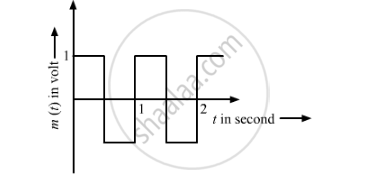
The modulating signal is a square wave as shown. Find modulation index.
Advertisements
Solution
Modulation index (μ) is the ratio of the amplitude of the modulating signal to the amplitude of the carrier wave.
The generalised equation of a carrier wave is given below:
c(t) =Acsinωct
The generalised equation of a modulating wave is given below:
cm(t)=Acsinωct+μAcsinωmtsinωct
Here, μ is defined as `A_m/A_c`
On comparing this with the equations of carrier wave and modulating wave, we get:
Amplitude of modulating signal, Am=1 V
Amplitude of carrier wave, Ac=2 V
`:.mu=A_m/A_c=1/2=0.5`
APPEARS IN
RELATED QUESTIONS
State three important factors showing the need for translating a low frequency signal into a high frequency wave before transmission
What is the role of a bandpass filter?
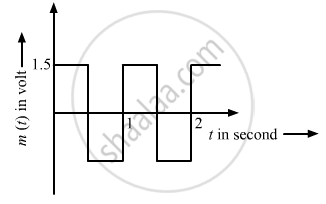
The carrier wave of a signal is given by C(t) = 3 sin (8πt) volt. The modulating signal is a square wave as shown. Find its modulation index.
Define the term modulation. Draw a block diagram of a simple modulator for obtaining AM signal ?
In the block diagram of a simple modulator for obtaining an AM signal, shown in the figure, identify the boxes A and B. Write their function.

Given modulation index physical significance .For an amplitude modulated wave, the maximum amplitude is found to be 10 V while the minimum amplitude is 2 V. Determine the modulation index μ ?
Answer the following question.
Why a signal transmitted from a TV tower cannot be received beyond a certain distance? Write the expression for the optimum separation between the receiving and the transmitting antenna.
An audio signal of 15kHz frequency cannot be transmitted over long distances without modulation because ______.
- the size of the required antenna would be at least 5 km which is not convenient.
- the audio signal can not be transmitted through sky waves.
- the size of the required antenna would be at least 20 km, which is not convenient.
- effective power transmitted would be very low, if the size of the antenna is less than 5 km.
A TV transmission tower antenna is at a height of 20 m. How much service area can it cover if the receiving antenna is (i) at ground level, (ii) at a height of 25 m? Calculate the percentage increase in area covered in case (ii) relative to case (i).
A transmitting antenna has a height of 320 m and that of receiving antenna is 2000 m. The maximum distance between them for satisfactory communication in line of sight mode is 'd'. The value of 'd' is ______ km.
