Advertisements
Advertisements
प्रश्न
The carrier wave is given by
C(t) = 2sin(8πt) volt.
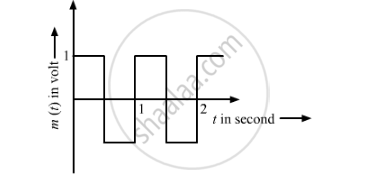
The modulating signal is a square wave as shown. Find modulation index.
Advertisements
उत्तर
Modulation index (μ) is the ratio of the amplitude of the modulating signal to the amplitude of the carrier wave.
The generalised equation of a carrier wave is given below:
c(t) =Acsinωct
The generalised equation of a modulating wave is given below:
cm(t)=Acsinωct+μAcsinωmtsinωct
Here, μ is defined as `A_m/A_c`
On comparing this with the equations of carrier wave and modulating wave, we get:
Amplitude of modulating signal, Am=1 V
Amplitude of carrier wave, Ac=2 V
`:.mu=A_m/A_c=1/2=0.5`
APPEARS IN
संबंधित प्रश्न
The process of superimposing a low frequency signal on a high frequency wave is_______ .
A carrier wave of peak voltage 12 V is used to transmit a message signal. What should be the peak voltage of the modulating signal in order to have a modulation index of 75%?
In a communication system, what is meant by modulation?
State any two types of modulation
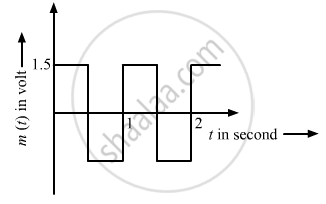
The carrier wave of a signal is given by C(t) = 3 sin (8πt) volt. The modulating signal is a square wave as shown. Find its modulation index.
In the block diagram of a simple modulator for obtaining an AM signal, shown in the figure, identify the boxes A and B. Write their function.

A 20 volt AC is applied to a circuit consisting of a resistance and a coil with negligible resistance. If the voltage across the resistance is 12 volt, the voltage across the coil is ______.
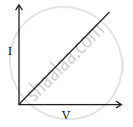
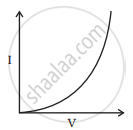
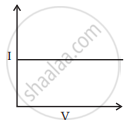
I-V characteristics of four devices are shown in Figures.
 |
 |
 |
|
| (i) | (ii) | (iii) | (iv) |
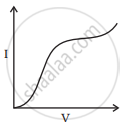
Identify devices that can be used for modulation.
A TV transmission tower antenna is at a height of 20 m. How much service area can it cover if the receiving antenna is (i) at ground level, (ii) at a height of 25 m? Calculate the percentage increase in area covered in case (ii) relative to case (i).
A carrier wave Vc(t) = 160 sin(2π × 106t) volts is made to vary between Vmax = 200 V and Vmin = 120 V by a message signal Vm(t) = Am sin(2π × 103t) volts. The peak voltage Am of the modulating signal is ______.
