Please select a subject first
Advertisements
Advertisements
(a) Derive the relation between the decay constant and half life of a radioactive substance.
(b) A radioactive element reduces to 25% of its initial mass in 1000 years. Find its half life.
Concept: Law of Radioactive Decay
Define 'activity' of a radioactive substance ?
Concept: Law of Radioactive Decay
Two different radioactive elements with half lives T1 and T2 have N1 and N2 undecayed atoms respectively present at a given instant. Derive an expression for the ratio of their activities at this instant in terms of N1 and N2 ?
Concept: Law of Radioactive Decay
Write the β-decay of tritium in symbolic form.
Concept: Radioactivity >> Beta Decay
Why is it experimentally found difficult to detect neutrinos in this process ?
Concept: Law of Radioactive Decay
What is the significance of negative sign in the expression for the energy?
Concept: Forms of Energy > Nuclear Energy >> Nuclear Reactor
Write any two characteristic properties of nuclear force.
Concept: Forms of Energy > Nuclear Energy >> Nuclear Reactor
Using the curve for the binding energy per nucleon as a function of mass number A, state clearly how the release in energy in the processes of nuclear fission and nuclear fusion can be explained.
Concept: Mass-energy and Nuclear Binding Energy >> Mass - Energy
A heavy nucleus X of mass number 240 and binding energy per nucleon 7.6 MeV is split into two fragments Y and Z of mass numbers 110 and 130. The binding energy of nucleons in Y and Z is 8.5 MeV per nucleon. Calculate the energy Q released per fission in MeV.
Concept: Mass-energy and Nuclear Binding Energy >> Mass - Energy
Two nuclei have mass numbers in the ratio 1: 2. What is the ratio of their nuclear densities?
Concept: Atomic Masses and Composition of Nucleus
A radioactive nucleus ‘A’ undergoes a series of decays according to the following scheme:

The mass number and atomic number of A are 180 and 72 respectively. What are these numbers for A4?
Concept: Law of Radioactive Decay
The radioactive isotope D decays according to the sequence
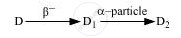
If the mass number and atomic number of D2 are 176 and 71 respectively, what is (i) the mass number (ii) atomic number of D?
Concept: Law of Radioactive Decay
Which property of nuclear force explains the constancy of binding energy per nucleon `((BE)/A)` for nuclei in the range 20< A < 170 ?
Concept: Mass-energy and Nuclear Binding Energy >> Nuclear Binding Energy
Define the term 'decay constant' of a radioactive sample. The rate of disintegration of a given radioactive nucleus is 10000 disintegrations/s and 5,000 disintegrations/s after 20 hr. and 30 hr. respectively from start. Calculate the half-life and the initial number of nuclei at t= 0.
Concept: Law of Radioactive Decay
Write two distinguishing features of nuclear forces.
Concept: Nuclear Force
Complete the following nuclear reactions for α and β deca :
(i) `"_92^238U ->? + _2^4He + Q`
(ii) `"_11^22Na ->? + _10^22Ne + v`
Concept: Forms of Energy > Nuclear Energy >> Nuclear Reactor
Determine the distance of the closest approach when an alpha particle of kinetic energy 4.5 MeV strikes a nucleus of Z = 80, stops and reverses its direction.
Concept: Radioactivity >> Alpha Decay
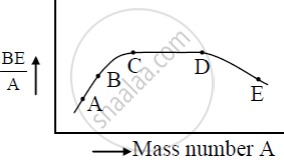
The figure shows the plot of binding energy (BE) per nucleon as a function of mass number A. The letters A, B, C, D, and E represent the positions of typical nuclei on the curve. Point out, giving reasons, the two processes (in terms of A, B, C, D, and E ), one of which can occur due to nuclear fission and the other due to nuclear fusion.
Concept: Mass-energy and Nuclear Binding Energy >> Nuclear Binding Energy
Identify the nature of the radioactive radiations emitted in each step of the decay process given below.
`""_Z^A X -> _Z^A _-1^-4 Y ->_Z^A _-1^-4 W`
Concept: Law of Radioactive Decay
A radioactive substance disintegrates into two types of daughter nuclei, one type with disintegration constant λ1 and the other type with disintegration constant λ2 . Determine the half-life of the radioactive substance.
Concept: Law of Radioactive Decay
