Advertisements
Advertisements
Question
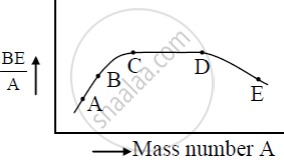
The figure shows the plot of binding energy (BE) per nucleon as a function of mass number A. The letters A, B, C, D, and E represent the positions of typical nuclei on the curve. Point out, giving reasons, the two processes (in terms of A, B, C, D, and E ), one of which can occur due to nuclear fission and the other due to nuclear fusion.
Advertisements
Solution
The nuclei at A and B undergo nuclear fusion as their binding energy per nucleon is small and they are less stable so they fuse with other nuclei to become stable. The nuclei at E undergo nuclear fission as its binding energy per nucleon is less it splits into two or more lighter nuclei and becomes stable.
APPEARS IN
RELATED QUESTIONS
Write symbolically the nuclear β+ decay process of `""_6^11C` Is the decayed product X an isotope or isobar of (`""_6^11C`)? Given the mass values m (`""_6^11C`) = 11.011434 u and m (X) = 11.009305 u. Estimate the Q-value in this process.
What is meant by the terms half-life of a radioactive substance and binding energy of a nucleus?
Use this graph to explain the release of energy in both the processes of nuclear fusion and fission.
In which of the following decays the atomic number decreases?
(a) α-decay
(b) β+-decay
(c) β−-decay
(d) γ-decay
Binding energy per nucleon for helium nucleus (2 He) is 7.0 MeV Find value of mass defect for helium nucleus
Calculate the binding energy of an alpha particle given its mass to be 4.00151 u.
A body's centre of mass
He23 and He13 nuclei have the same mass number. Do they have the same binding energy?
The deuteron is bound by nuclear forces just as H-atom is made up of p and e bound by electrostatic forces. If we consider the force between neutron and proton in deuteron as given in the form of a Coulomb potential but with an effective charge e′: F = `1/(4πε_0) e^('2)/r` estimate the value of (e’/e) given that the binding energy of a deuteron is 2.2 MeV.
What is meant by “binding energy per nucleon” of a nucleus?
