Advertisements
Advertisements
प्रश्न
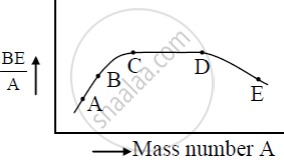
The figure shows the plot of binding energy (BE) per nucleon as a function of mass number A. The letters A, B, C, D, and E represent the positions of typical nuclei on the curve. Point out, giving reasons, the two processes (in terms of A, B, C, D, and E ), one of which can occur due to nuclear fission and the other due to nuclear fusion.
Advertisements
उत्तर
The nuclei at A and B undergo nuclear fusion as their binding energy per nucleon is small and they are less stable so they fuse with other nuclei to become stable. The nuclei at E undergo nuclear fission as its binding energy per nucleon is less it splits into two or more lighter nuclei and becomes stable.
APPEARS IN
संबंधित प्रश्न
What is meant by the terms half-life of a radioactive substance and binding energy of a nucleus?
Define half-life of a radioactive substance
Define the terms (i) half-life (T1/2) and (ii) average life (τ). Find out their relationships with the decay constant (λ).
If the nucleons of a nucleus are separated from each other, the total mass is increased. Where does this mass come from?
Answer the following question.
Draw the curve showing the variation of binding energy per nucleon with the mass number of nuclei. Using it explains the fusion of nuclei lying on the ascending part and fission of nuclei lying on the descending part of this curve.
Determine the binding energy per nucleon of the americium isotope \[\ce{_95^244Am}\], given the mass of \[\ce{_95^244Am}\] to be 244.06428 u.
The difference in mass of a nucleus and its constituents is called ______.
Tritium is an isotope of hydrogen whose nucleus Triton contains 2 neutrons and 1 proton. Free neutrons decay into `p + bare + barν`. If one of the neutrons in Triton decays, it would transform into He3 nucleus. This does not happen. This is because ______.
Find the binding energy of a H-atom in the state n = 2
Calculate the values of x and y in the following nuclear reaction.
\[\ce{^227_89Ac -> ^211_82Pb + x[^4_2He]+ y[^0_-1e]}\]
