English

The Radioactive Isotope D Decays According to the Sequenceif the Mass Number and Atomic Number of D2 Are 176 and 71 Respectively, What is (I) the Mass Number (Ii) Atomic Number of D? - Physics

Advertisements
Advertisements

Question

The radioactive isotope D decays according to the sequence
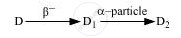
If the mass number and atomic number of D2 are 176 and 71 respectively, what is (i) the mass number (ii) atomic number of D?

Advertisements

Solution

An alpha (α) particle is a helium nucleus (`""_2^4He)`and a beta-minus decay (β) is an emission of an electron.

The substance D2 can be represented as `""_71^176D_2`.
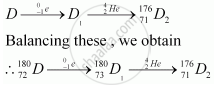
Hence,

(i) The mass number of D is 180.

(ii) The atomic number of is 72.

shaalaa.com
  Is there an error in this question or solution?
2006-2007 (March) Delhi set 1

Video TutorialsVIEW ALL [1]

RELATED QUESTIONS


(a) Write the basic nuclear process involved in the emission of β+ in a symbolic form, by a radioactive nucleus.

(b) In the reactions given below:

(i)`""_16^11C->_y^zB+x+v`

(ii)`""_6^12C+_6^12C->_a^20 Ne + _b^c He`

Find the values of x, y, and z and a, b and c.


A radioactive isotope has a half-life of T years. How long will it take the activity to reduce to a) 3.125%, b) 1% of its original value?


Define the activity of a given radioactive substance. Write its S.I. unit.


28Th emits an alpha particle to reduce to 224Ra. Calculate the kinetic energy of the alpha particle emitted in the following decay:

`""^228"Th" → ""^224"Ra"^(∗) + alpha`

`""^224"Ra"^(∗) → ""^224"Ra" + γ (217 "keV")`.

Atomic mass of 228Th is 228.028726 u, that of 224Ra is 224.020196 u and that of  `""_2^4H` is 4.00260 u.

(Use Mass of proton mp = 1.007276 u, Mass of `""_1^1"H"` atom = 1.007825 u, Mass of neutron mn = 1.008665 u, Mass of electron = 0.0005486 u ≈ 511 keV/c2,1 u = 931 MeV/c2.)


57Co decays to 57Fe by β+- emission. The resulting 57Fe is in its excited state and comes to the ground state by emitting γ-rays. The half-life of β+- decay is 270 days and that of the γ-emissions is 10−8 s. A sample of 57Co gives 5.0 × 10⁹ gamma rays per second. How much time will elapse before the emission rate of gamma rays drops to 2.5 × 10⁹per second?


A radioactive isotope is being produced at a constant rate dN/dt = R in an experiment. The isotope has a half-life t1/2. Show that after a time t >> t1/2 the number of active nuclei will become constant. Find the value of this constant.


Disintegration rate of a sample is 1010 per hour at 20 hours from the start. It reduces to 6.3 x 10⁹ per hour after 30 hours. Calculate its half-life and the initial number of radioactive atoms in the sample.


Before the year 1900 the activity per unit mass of atmospheric carbon due to the presence of 14C averaged about 0.255 Bq per gram of carbon.
(a) What fraction of carbon atoms were 14C?
(b) An archaeological specimen containing 500 mg of carbon, shows 174 decays in one hour. What is the age of the specimen, assuming that its activity per unit mass of carbon when the specimen died was equal to the average value of the air? The half-life of 14C is 5730 years.


Which one of the following nuclei has shorter meant life?


The half-life of the radioactive substance is 40 days. The substance will disintegrate completely in


Share
Notifications

Englishहिंदीमराठी


      Forgot password?
Use app×