मराठी

The Radioactive Isotope D Decays According to the Sequenceif the Mass Number and Atomic Number of D2 Are 176 and 71 Respectively, What is (I) the Mass Number (Ii) Atomic Number of D? - Physics

Advertisements
Advertisements

प्रश्न

The radioactive isotope D decays according to the sequence
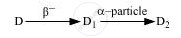
If the mass number and atomic number of D2 are 176 and 71 respectively, what is (i) the mass number (ii) atomic number of D?

Advertisements

उत्तर

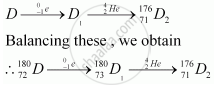
An alpha (α) particle is a helium nucleus (`""_2^4He)`and a beta-minus decay (β) is an emission of an electron.

The substance D2 can be represented as `""_71^176D_2`.
Hence,

(i) The mass number of D is 180.

(ii) The atomic number of is 72.

shaalaa.com
  या प्रश्नात किंवा उत्तरात काही त्रुटी आहे का?
2006-2007 (March) Delhi set 1

व्हिडिओ ट्यूटोरियलVIEW ALL [1]

संबंधित प्रश्‍न

How is the mean life of a given radioactive nucleus related to the decay constant?


The half-life of `""_38^90 "Sr"` is 28 years. What is the disintegration rate of 15 mg of this isotope?


The decay constant of a radioactive sample is λ. The half-life and the average-life of the sample are respectively


When charcoal is prepared from a living tree, it shows a disintegration rate of 15.3 disintegrations of 14C per gram per minute. A sample from an ancient piece of charcoal shows 14C activity to be 12.3 disintegrations per gram per minute. How old is this sample? Half-life of 14C is 5730 y.


Disintegration rate of a sample is 1010 per hour at 20 hours from the start. It reduces to 6.3 x 10⁹ per hour after 30 hours. Calculate its half-life and the initial number of radioactive atoms in the sample.


A source contains two species of phosphorous nuclei, \[\ce{_15^32P}\] (T1/2 = 14.3 d) and \[\ce{_15^33P}\] (T1/2 = 25.3 d). At time t = 0, 90% of the decays are from \[\ce{_15^32P}\]. How much time has to elapse for only 15% of the decays to be from \[\ce{_15^32P}\]?


Before the year 1900 the activity per unit mass of atmospheric carbon due to the presence of 14C averaged about 0.255 Bq per gram of carbon.
(a) What fraction of carbon atoms were 14C?
(b) An archaeological specimen containing 500 mg of carbon, shows 174 decays in one hour. What is the age of the specimen, assuming that its activity per unit mass of carbon when the specimen died was equal to the average value of the air? The half-life of 14C is 5730 years.


Two radioactive materials Y1 and Y2 have decay constants '5`lambda`' and `lambda` respectively. Initially they have same number of nuclei. After time 't', the ratio of number of nuclei of Y1 to that of Y2 is `1/"e"`, then 't' is equal to ______.


If 10% of a radioactive material decay in 5 days, then the amount of original material left after 20 days is approximately :


What is the half-life period of a radioactive material if its activity drops to 1/16th of its initial value of 30 years?


Share
Notifications

Englishहिंदीमराठी


      Forgot password?
Use app×