Please select a subject first
Advertisements
Advertisements
Trace the rays of light showing the formation of an image due to a point object placed on the axis of a spherical surface separating the two media of refractive indices n1 and n2. Establish the relation between the distances of the object, the image and the radius of curvature from the central point of the spherical surface.
Hence derive the expression of the lens maker’s formula.
Concept: Thin Lens Formula
Draw the labelled ray diagram for the formation of image by a compound microscope.
Derive the expression for the total magnification of a compound microscope. Explain why both the objective and the eyepiece of a compound microscope must have short focal lengths.
Concept: Optical Instruments >> Simple Microscope or a Reading Glass
An equilateral glass prism has a refractive index 1.6 in the air. Calculate the angle of minimum deviation of the prism, when kept in a medium of refractive index `4sqrt(2)"/"5.`
Concept: Dispersion by a Prism
How does the angle of minimum deviation of a glass prism vary if the incident violet light is replaced by red light?
Concept: Dispersion by a Prism
For paraxial rays, show that the focal length of a spherical mirror is one-half of its radius of curvature.
Concept: Ray Optics - Mirror Formula
When light travels from an optically denser medium to a rarer medium, why does the critical angle of incidence depend on the colour of light?
Concept: Rarer and Denser Medium
When a wave is propagating from a rarer to a denser medium, which characteristic of the wave does not change and why?
Concept: Rarer and Denser Medium
A point-object is placed on the principal axis of convex spherical surface of radius of curvature R, which separates the two media of refractive indices n1 and n2 (n2>n1). Draw the ray diagram and deduce the relation between the distance of the object (u), distance of the image (v) and the radius of curvature (R for refraction to take place at the convex spherical surface from rarer to denser medium.
Concept: Rarer and Denser Medium
Use the above relation to obtain the condition on the position of the object and the radius of curvature in terms of n1and n2 when the real image is formed.
Concept: Refraction at a Spherical Surface and Lenses >> Refraction at Spherical Surfaces
Draw a labelled ray diagram showing the formation of image by a compound microscope in normal adjustment. Derive the expression for its magnifying power.
Concept: Optical Instruments >> Simple Microscope or a Reading Glass
How does the resolving power of a microscope change when
(i) the diameter of the objective lens is decreased?
(ii) the wavelength of the incident light is increased ?
Justify your answer in each case.
Concept: Optical Instruments >> Simple Microscope or a Reading Glass
Answer the following question.
An optical instrument uses a lens of 100 D for the objective lens and 50 D for its eyepiece. When the tube length is kept at 20 cm, the final image is formed at infinity.
(a) Identify the optical instrument.
(b) Calculate the magnification produced by the instrument.
Concept: Refraction at a Spherical Surface and Lenses >> Refraction by a Lens
Draw a ray diagram of compound microscope for the final image formed at least distance of distinct vision?
Concept: Optical Instruments >> Simple Microscope or a Reading Glass
A small telescope has an objective lens of focal length 140 cm and an eyepiece of focal length 5.0 cm. Find the magnifying power of the telescope for viewing distant objects when
- the telescope is in normal adjustment,
- the final image is formed at the least distance of distinct vision.
Concept: Optical Instruments >> Telescope
The focal length of a convex lens made of glass of refractive index (1.5) is 20 cm.
What will be its new focal length when placed in a medium of refractive index 1.25?
Is focal length positive or negative? What does it signify?
Concept: Reflection of Light by Spherical Mirrors
| Case study: Mirage in deserts |
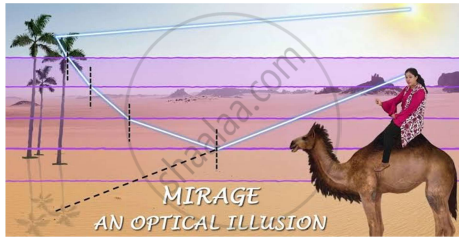 |
|
To a distant observer, the light appears to be coming from somewhere below the ground. The observer naturally assumes that light is being reflected from the ground, say, by a pool of water near the tall object. Such inverted images of distant tall objects cause an optical illusion to the observer. This phenomenon is called mirage. This type of mirage is especially common in hot deserts. Based on the above facts, answer the following question: |
Which of the following phenomena is prominently involved in the formation of mirage in deserts?
Concept: Some Natural Phenomena Due to Sunlight
An angular magnification of 30X is desired using an objective of focal length 1.25 cm and an eye piece of focal length 5 cm. How will you set up the compound microscope for the final image formed at least distance of distinct vision?
Concept: Optical Instruments >> Simple Microscope or a Reading Glass
| Case study: Mirage in deserts |
 |
|
To a distant observer, the light appears to be coming from somewhere below the ground. The observer naturally assumes that light is being reflected from the ground, say, by a pool of water near the tall object. Such inverted images of distant tall objects cause an optical illusion to the observer. This phenomenon is called mirage. This type of mirage is especially common in hot deserts. Based on the above facts, answer the following question : |
A diver at a depth 12 m inside water `(a_(µω) = 4/3)` sees the sky in a cone of semi-vertical angle
Concept: Some Natural Phenomena Due to Sunlight
| Case study: Mirage in deserts |
|
|
To a distant observer, the light appears to be coming from somewhere below the ground. The observer naturally assumes that light is being reflected from the ground, say, by a pool of water near the tall object. Such inverted images of distant tall objects cause an optical illusion to the observer. This phenomenon is called mirage. This type of mirage is especially common in hot deserts. Based on the above facts, answer the following question : |
In an optical fibre, if n1 and n2 are the refractive indices of the core and cladding, then which among the following, would be a correct equation?
Concept: Some Natural Phenomena Due to Sunlight
| Case study: Mirage in deserts |
|
|
To a distant observer, the light appears to be coming from somewhere below the ground. The observer naturally assumes that light is being reflected from the ground, say, by a pool of water near the tall object. Such inverted images of distant tall objects cause an optical illusion to the observer. This phenomenon is called mirage. This type of mirage is especially common in hot deserts. Based on the above facts, answer the following question: |
A diamond is immersed in such a liquid which has its refractive index with respect to air as greater than the refractive index of water with respect to air. Then the critical angle of diamond-liquid interface as compared to critical angle of diamond-water interface will
Concept: Some Natural Phenomena Due to Sunlight
