Please select a subject first
Advertisements
Advertisements
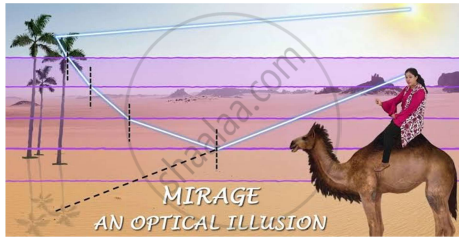
| Case study: Mirage in deserts |
 |
|
To a distant observer, the light appears to be coming from somewhere below the ground. The observer naturally assumes that light is being reflected from the ground, say, by a pool of water near the tall object. Such inverted images of distant tall objects cause an optical illusion to the observer. This phenomenon is called mirage. This type of mirage is especially common in hot deserts. Based on the above facts, answer the following question: |
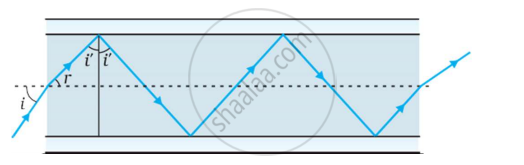
The following figure shows a cross-section of a ‘light pipe’ made of a glass fiber of refractive index 1.68. The outer covering of the pipe is made of a material of refractive index 1.44. What is the range of the angles of the incident rays with the axis of the pipe for the following phenomena to occur.
Concept: Some Natural Phenomena Due to Sunlight
Read the following paragraph and answer the questions.
| A number of optical devices and instruments have been designed and developed such as periscope, binoculars, microscopes and telescopes utilising the reflecting and refracting properties of mirrors, lenses and prisms. Most of them are in common use. Our knowledge about the formation of images by the mirrors and lenses is the basic requirement for understanding the working of these devices. |
- Why the image formed at infinity is often considered most suitable for viewing. Explain
- In modern microscopes, multicomponent lenses are used for both the objective and the eyepiece. Why?
- Write two points of difference between a compound microscope and an astronomical telescope
OR
Write two distinct advantages of a reflecting type telescope over a refracting type telescope.
Concept: Optical Instruments >> Telescope
With the help of a ray diagram, show how a compound microscope forms a magnified image of a tiny object, at least distance of distinct vision. Hence derive an expression for the magnification produced by it.
Concept: Optical Instruments >> Simple Microscope or a Reading Glass
Define the critical angle for a given pair of media and total internal reflection. Obtain the relation between the critical angle and refractive index of the medium.
Concept: Refraction at a Spherical Surface and Lenses >> Refraction at Spherical Surfaces
A point object in the air is placed symmetrically at a distance of 60 cm in front of a concave spherical surface with a refractive index of 1.5. If the radius of curvature of the surface is 20 cm, find the position of the image formed.
Concept: Refraction at a Spherical Surface and Lenses >> Refraction at Spherical Surfaces
- Assertion (A): Propagation of light through an optical fibre is due to total internal reflection taking place at the core-cladding interface.
- Reason (R): Refractive index of the material of the cladding of the optical fibre is greater than that of the core.
Concept: Total Internal Reflection
Show that the least possible distance between an object and its real image in a convex lens is 4f, where f is the focal length of the lens.
Concept: Refraction at a Spherical Surface and Lenses >> Refraction by a Lens
In an astronomical telescope in normal adjustment, a straight black line of length L is drawn on the objective lens. The eyepiece forms a real image of this line whose length is 𝑙. What is the angular magnification of the telescope?
Concept: Optical Instruments >> Telescope
A converging lens has a focal length of 10 cm in air. It is made of a material with a refractive index of 1.6. If it is immersed in a liquid of refractive index 1.3, find its new focal length.
Concept: Reflection of Light by Spherical Mirrors
Draw the sketches to differentiate between plane wavefront and spherical wavefront.
Concept: Introduction of Wave Optics
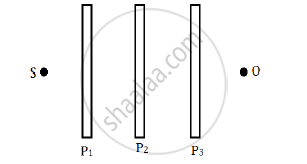
Three identical polaroid sheets P1, P2 and P3 are oriented so that the pass axis of P2 and P3 are inclined at angles of 60° and 90° respectively with the pass axis of P1. A monochromatic source S of unpolarised light of intensity I0 is kept in front of the polaroid sheet P1 as shown in the figure. Determine the intensities of light as observed by the observer at O, when polaroid P3 is rotated with respect to P2 at angles θ = 30° and 60°.
Concept: Polarisation
The intensity at the central maxima in Young’s double slit experiment is I0. Find out the intensity at a point where the path difference is` lambda/6,lambda/4 and lambda/3.`
Concept: Interference of Light Waves and Young’s Experiment
Write the important characteristic features by which the interference can be distinguished from the observed diffraction pattern.
Concept: Interference
Show, using a simple polaroid, that light waves are transverse in nature. Intensity of light coming out of a polaroid does not change irrespective of the orientation of the pass axis of the polaroid. Explain why.
Concept: Polarisation
In young’s double slit experiment, deduce the conditions for obtaining constructive and destructive interference fringes. Hence, deduce the expression for the fringe width.
Concept: Interference of Light Waves and Young’s Experiment
Show that the fringe pattern on the screen is actually a superposition of slit diffraction from each slit.
Concept: Interference of Light Waves and Young’s Experiment
What should be the width of each slit to obtain 10 maxima of the double slit pattern within the central maximum of the single slit pattern, for green light of wavelength 500 nm, if the separation between two slits is 1 mm?
Concept: Width of Central Maximum
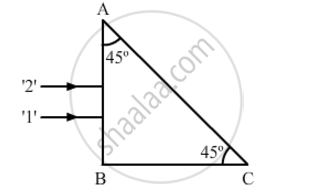
Two monochromatic rays of light are incident normally on the face AB of an isosceles right-angled prism ABC. The refractive indices of the glass prism for the two rays '1' and '2' are respectively 1.3 and 1.5. Trace the path of these rays after entering the prism.
Concept: Refraction of Monochromatic Light
Show, with the help of a diagram, how unpolarised sunlight gets polarised due to scattering.
Concept: Polarisation
Two polaroids P1 and P2 are placed with their pass axes perpendicular to each other. An unpolarised light of intensity Io is incident on P1. A third polaroid P3 is kept in between P1 and P2 such that its pass axis makes an angle of 45° with that of P1. Determine the intensity of light transmitted through P1, P2 and P3
Concept: Polarisation
