Advertisements
Advertisements
Question
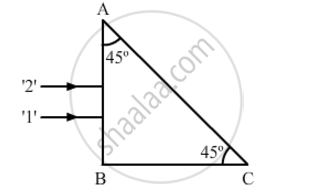
Two monochromatic rays of light are incident normally on the face AB of an isosceles right-angled prism ABC. The refractive indices of the glass prism for the two rays '1' and '2' are respectively 1.3 and 1.5. Trace the path of these rays after entering the prism.
Advertisements
Solution
Critical angle of ray 1:
`sin(c_1)=1/mu_1=1/1.3`
`=>c_1=sin^(-1)(1/1.3)=50.35^@`
Similarly, critical angle of ray 2:
`sin(c_2)=1/mu_0=1/1.52`
`=>c_2=sin^(-1)(1/1.52)=41.14^@`
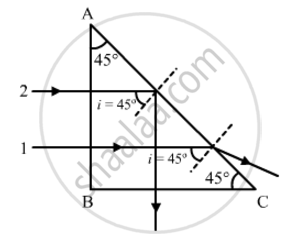
Both the rays will fall on the side AC with angle of incidence (i) equal to 45°. Critical angle of ray 1 is greater than that of i. Hence, it will emerge from the prism as shown in the figure. Critical angle of ray 2 is less than that of i. Hence, it will be internally reflected as shown in the figure
APPEARS IN
RELATED QUESTIONS
Monochromatic light of frequency 6.0 × 10¹⁴ Hz is produced by a laser. The power emitted is 2.0 × 10⁻³ W. Estimate the number of photons emitted per second on an average by the source
'Two independent monochromatic sources of light cannot produce a sustained interference pattern'. Give reason.
What kind of fringes do you expect to observe if white light is used instead of monochromatic light?
When monochromatic light travels from a rarer to a denser medium, explain the following, giving reasons:
(i) Is the frequency of reflected and refracted light same as the frequency of incident light?
(ii) Does the decrease in speed imply a reduction in the energy carried by light wave?
When monochromatic light is incident on a surface separating two media, why does the refracted light have the same frequency as that of the incident light?
"Monochromatic light should be used to produce pure spectrum". Comment on this statement.
Using the monochromatic light of the wavelength in the experimental set-up of the diffraction pattern as well as in the interference pattern where the slit separation is 1 mm, 10 interference fringes are found to be within the central maximum of the diffraction pattern. Determine the width of the single slit, if the screen is kept at the same distance from the slit in the two cases.
A monochromatic ray of light falls on a regular prism under minimum deviation condition. What is the relation between angle of incidence and angle of emergence?
For constructive interference to take place between two monochromatic light waves of wavelength λ, the path difference should be ______.
A narrow slit is illuminated by a parallel beam of monochromatic light of wavelength λ equal to 6000 Å and the angular width of the central maximum in the resulting diffraction pattern is measured. When the slit is next illuminated by light of wavelength λ’, the angular width decreases by 30%. Calculate the value of the wavelength λ’.
