Advertisements
Advertisements
Question
Draw a ray diagram of compound microscope for the final image formed at least distance of distinct vision?
Advertisements
Solution
Diagram of Compound Microscope for the final image formed at D:
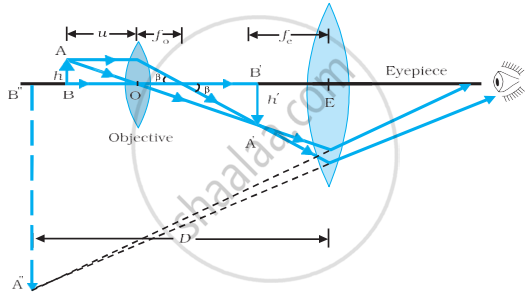
APPEARS IN
RELATED QUESTIONS
How can the resolving power of a compound microscope be increased? Use relevant formula to support your answer.
Suggest two ways by which the resolving power of a microscope can be increased?
Distinguish between myopia and hypermetropia. Show diagrammatically how these defects can be corrected.
Draw the labelled ray diagram for the formation of image by a compound microscope.
Derive the expression for the total magnification of a compound microscope. Explain why both the objective and the eyepiece of a compound microscope must have short focal lengths.
The focal length of the objective of a compound microscope if fo and its distance from the eyepiece is L. The object is placed at a distance u from the objective. For proper working of the instrument,
(a) L < u
(b) L > u
(c) fo < L < 2fo
(d) L > 2fo
An eye can distinguish between two points of an object if they are separated by more than 0.22 mm when the object is placed at 25 cm from the eye. The object is now seen by a compound microscope having a 20 D objective and 10 D eyepiece separated by a distance of 20 cm. The final image is formed at 25 cm from the eye. What is the minimum separation between two points of the object which can now be distinguished?
compound microscope consists of two convex lenses of focal length 2 cm and 5 cm. When an object is kept at a distance of 2.1 cm from the objective, a virtual and magnified image is fonned 25 cm from the eye piece. Calculate the magnifying power of the microscope.
How does the resolving power of a microscope change when
(i) the diameter of the objective lens is decreased?
(ii) the wavelength of the incident light is increased ?
Justify your answer in each case.
| A compound microscope consists of two converging lenses. One of them, of smaller aperture and smaller focal length, is called objective and the other of slightly larger aperture and slightly larger focal length is called eye-piece. Both lenses are fitted in a tube with an arrangement to vary the distance between them. A tiny object is placed in front of the objective at a distance slightly greater than its focal length. The objective produces the image of the object which acts as an object for the eye-piece. The eye-piece, in turn, produces the final magnified image. |
The magnification due to a compound microscope does not depend upon ______.
In a compound microscope an object is placed at a distance of 1.5 cm from the objective of focal length 1.25 cm. If the eye-piece has a focal length of 5 cm and the final image is formed at the near point, find the magnifying power of the microscope.
