हिंदी

Draw a ray diagram of compound microscope for the final image formed at least distance of distinct vision? An angular magnification of 30X is desired using an objective of focal length 1.25 cm and an - Physics

Advertisements
Advertisements

प्रश्न

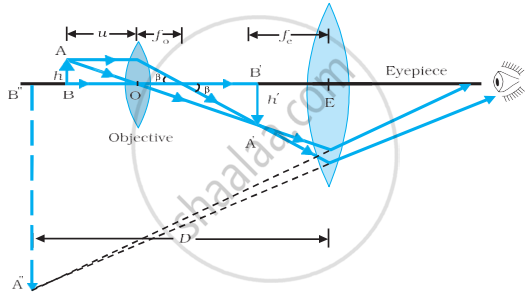
Draw a ray diagram of compound microscope for the final image formed at least distance of distinct vision?

संक्षेप में उत्तर
Advertisements

उत्तर

Diagram of Compound Microscope for the final image formed at D:
shaalaa.com
  क्या इस प्रश्न या उत्तर में कोई त्रुटि है?
2021-2022 (March) Term 2 Sample

वीडियो ट्यूटोरियलVIEW ALL [2]

संबंधित प्रश्न

Magnifying power of a simple microscope is inversely proportional to the focal length of the lens. What then stops us from using a convex lens of smaller and smaller focal length and achieving greater and greater magnifying power?


Why must both the objective and the eyepiece of a compound microscope have short focal lengths?


Define resolving power of a microscope and write one factor on which it depends


Draw a ray diagram showing image formation in a compound microscope ?


A compound microscope forms an inverted image of an object. In which of the following cases it it likely to create difficulties? 


The separation between the objective and the eyepiece of a compound microscope can be adjusted between 9.8 cm to 11.8 cm. If the focal lengths of the objective and the eyepiece are 1.0 cm and 6 cm respectively, find the range of the magnifying power if the image is always needed at 24 cm from the eye


Draw a neat labelled ray diagram showing the formation of an image at the least distance of distinct vision D by a simple microscope. When the final image is at D, derive an expression for its magnifying power at D. 


compound microscope consists of two convex lenses of focal length 2 cm and 5 cm. When an object is kept at a distance of 2.1 cm from the objective, a virtual and magnified image is fonned 25 cm from the eye piece.  Calculate the magnifying power of the microscope.


An angular magnification of 30X is desired using an objective of focal length 1.25 cm and an eye piece of focal length 5 cm. How will you set up the compound microscope for the final image formed at least distance of distinct vision?


The near vision of an average person is 25 cm. To view an object with an angular magnification of 10, what should be the power of the microscope?


Share
Notifications

Englishहिंदीमराठी


      Forgot password?
Use app×