English

Draw the Labelled Ray Diagram for the Formation of Image by a Compound Microscope. Derive the Expression for the Total Magnification of a Compound Microscope. Explain Why Both the Objective and - Physics

Advertisements
Advertisements

Question

Draw the labelled ray diagram for the formation of image by a compound microscope.

Derive the expression for the total magnification of a compound microscope. Explain why both the objective and the eyepiece of a compound microscope must have short focal lengths.

Advertisements

Solution
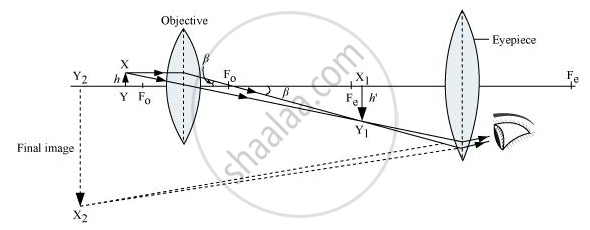
Show L in figure

`tan beta = h/(f_0)  .... (1)`

`tan beta = h'/L    ..... (2)`

`h'/h  =Lf_0`    [Using (1) and (2)]

`m_0 = h'/h = L/f_0` [Magnification due to objective]

`m_e = 1+D/f_e`

Net magnification (m) =`m_0m_e`

`|m = (L/f_0) (D/f_e)|`

f0 and fe are in denominator.

This formula contains foand fe in denominator. Therefore, both the objective and the eyepiece of a compound microscope must have short focal lengths.

shaalaa.com
  Is there an error in this question or solution?
2008-2009 (March) Delhi set 1

RELATED QUESTIONS

The total magnification produced by a compound microscope is 20. The magnification produced by the eye piece is 5. The microscope is focussed on a certain object. The distance between the objective and eyepiece is observed to be 14 cm. If least distance of distinct vision is 20 cm, calculate the focal length of the objective and the eye piece.


An angular magnification (magnifying power) of 30X is desired using an objective of focal length 1.25 cm and an eyepiece of focal length 5 cm. How will you set up the compound microscope?


Draw a ray diagram to show the working of a compound microscope. Deduce an expression for the total magnification when the final image is formed at the near point.

In a compound microscope, an object is placed at a distance of 1.5 cm from the objective of focal length 1.25 cm. If the eye piece has a focal length of 5 cm and the final image is formed at the near point, estimate the magnifying power of the microscope.


A simple microscope is rated 5 X for a normal relaxed eye. What will be its magnifying power for a relaxed farsighted eye whose near point is 40 cm?


A simple microscope using a single lens often shows coloured image of a white source. Why?


The separation between the objective and the eyepiece of a compound microscope can be adjusted between 9.8 cm to 11.8 cm. If the focal lengths of the objective and the eyepiece are 1.0 cm and 6 cm respectively, find the range of the magnifying power if the image is always needed at 24 cm from the eye


Draw a labelled ray diagram showing the formation of image by a compound microscope in normal adjustment. Derive the expression for its magnifying power.


A microscope is focussed on a mark on a piece of paper and then a slab of glass of thickness 3 cm and refractive index 1.5 is placed over the mark. How should the microscope be moved to get the mark in focus again?


In a compound microscope an object is placed at a distance of 1.5 cm from the objective of focal length 1.25 cm. If the eye-piece has a focal length of 5 cm and the final image is formed at the near point, find the magnifying power of the microscope.


What is meant by a microscope in normal use?


Share
Notifications

Englishहिंदीमराठी


      Forgot password?
Use app×