मराठी

Draw the Labelled Ray Diagram for the Formation of Image by a Compound Microscope. Derive the Expression for the Total Magnification of a Compound Microscope. Explain Why Both the Objective and - Physics

Advertisements
Advertisements

प्रश्न

Draw the labelled ray diagram for the formation of image by a compound microscope.

Derive the expression for the total magnification of a compound microscope. Explain why both the objective and the eyepiece of a compound microscope must have short focal lengths.

Advertisements

उत्तर
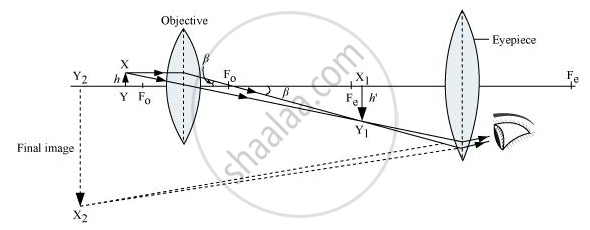
Show L in figure

`tan beta = h/(f_0)  .... (1)`

`tan beta = h'/L    ..... (2)`

`h'/h  =Lf_0`    [Using (1) and (2)]

`m_0 = h'/h = L/f_0` [Magnification due to objective]

`m_e = 1+D/f_e`

Net magnification (m) =`m_0m_e`

`|m = (L/f_0) (D/f_e)|`

f0 and fe are in denominator.

This formula contains foand fe in denominator. Therefore, both the objective and the eyepiece of a compound microscope must have short focal lengths.

shaalaa.com
  या प्रश्नात किंवा उत्तरात काही त्रुटी आहे का?
2008-2009 (March) Delhi set 1

व्हिडिओ ट्यूटोरियलVIEW ALL [2]

संबंधित प्रश्‍न

Define resolving power of a microscope and write one factor on which it depends


How is 'limit of resolution' related to resolving power of a microscope ?


A compound microscope has an objective of focal length 1.25 cm and eyepiece of focal length 5 cm. A small object is kept at 2.5 cm from the objective. If the final image formed is at infinity, find the distance between the objective and the eyepiece ?


Draw a ray diagram to show the working of a compound microscope. Deduce an expression for the total magnification when the final image is formed at the near point.

In a compound microscope, an object is placed at a distance of 1.5 cm from the objective of focal length 1.25 cm. If the eye piece has a focal length of 5 cm and the final image is formed at the near point, estimate the magnifying power of the microscope.


An object is placed at a distance u from a simple microscope of focal length f. The angular magnification obtained depends


The focal length of the objective of a compound microscope if fo and its distance from the eyepiece is L. The object is placed at a distance u from the objective. For proper working of the instrument,
(a) L < u
(b) L > u
(c) fo < < 2fo
(d) > 2fo


A simple microscope is rated 5 X for a normal relaxed eye. What will be its magnifying power for a relaxed farsighted eye whose near point is 40 cm?


Can the image formed by a simple microscope be projected on a screen without using any additional lens or mirror?


A compound microscope consists of an objective of focal length 1 cm and an eyepiece of focal length 5 cm. An object is placed at a distance of 0.5 cm from the objective. What should be the separation between the lenses so that the microscope projects an inverted real image of the object on a screen 30 cm behind the eyepiece?


The focal lengths of the objective and the eye-piece of a compound microscope are 1.0 cm and 2.5 cm respectively. Find the tube length of the microscope for obtaining a magnification of 300.


Share
Notifications

Englishहिंदीमराठी


      Forgot password?
Use app×