Advertisements
Advertisements
Question
For paraxial rays, show that the focal length of a spherical mirror is one-half of its radius of curvature.
Advertisements
Solution
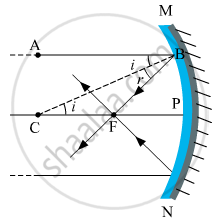
Consider a ray of light AB, parallel to the principal axis and incident on a spherical mirror at point B. The normal to the surface at point B is CB and CP = CB = R is the radius of curvature. The ray AB, after reflection from the mirror, will pass through F (concave mirror) or will appear to diverge from F (convex mirror) and obeys the law of reflection i.e. i = r.
From the geometry of the figure,
In Δ∆CFB,∠BCP =∠ABC = i (Alternate angles)
∠CBF = r
BF = FC (because i = r)
If the aperture of the mirror is small, B lies close to P, and therefore BF = PF
Or FC = FP = PF
Or PC = PF + FC = PF + PF
Or R = 2 PF = 2f
Or `"f" = "R"/2`
A similar relation holds for convex mirror also. In deriving this relation, we have assumed that the aperture of the mirror is small.
APPEARS IN
RELATED QUESTIONS
Calculate the distance of an object of height h from a concave mirror of radius of curvature 20 cm, so as to obtain a real image of magnification 2. Find the location of the image also.
Give two reasons to explain why a reflecting telescope is preferred over a refracting telescope.
Use the mirror equation to show that an object placed between f and 2f of a concave mirror produces a real image beyond 2f.
Use the mirror equation to show that a convex mirror always produces a virtual image independent of the location of the object.
Using mirror formula, explain why does a convex mirror always produce a virtual image.
An object is kept on the principal axis of a concave mirror of focal length 10 cm. at a distance of 15
cm from its pole. The image formed by the mirror is:
(a) Virtual and magnified
(b) Virtual and diminished
(c) Real and magnified
(d) Real and diminished
A point object O is placed at a distance of 15cm from a convex lens L of focal length 1 Ocm as shown in Figure 5 below. On the other side of the lens, a convex mirror M is placed such that its distance from the lens is equal to the focal length of the lens. The final image formed by this combination is observed to coincide with the object O. Find the focal length of the convex mirror

A light ray falling at an angle of 45° with the surface of a clean slab of ice of thickness 1.00 m is refracted into it at an angle of 30°. Calculate the time taken by the light rays to cross the slab. Speed of light in vacuum = 3 × 10⁸ m s−1.
Two plane mirrors are inclined at an angle of 40°. The possible number of images of an object placed at point P would be?

A point object is placed at a distance of 30 cm from a convex mirror of a focal length of 30 cm. What is the separation between the image and the object?
