Advertisements
Advertisements
प्रश्न
For paraxial rays, show that the focal length of a spherical mirror is one-half of its radius of curvature.
Advertisements
उत्तर
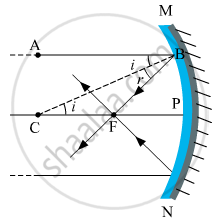
Consider a ray of light AB, parallel to the principal axis and incident on a spherical mirror at point B. The normal to the surface at point B is CB and CP = CB = R is the radius of curvature. The ray AB, after reflection from the mirror, will pass through F (concave mirror) or will appear to diverge from F (convex mirror) and obeys the law of reflection i.e. i = r.
From the geometry of the figure,
In Δ∆CFB,∠BCP =∠ABC = i (Alternate angles)
∠CBF = r
BF = FC (because i = r)
If the aperture of the mirror is small, B lies close to P, and therefore BF = PF
Or FC = FP = PF
Or PC = PF + FC = PF + PF
Or R = 2 PF = 2f
Or `"f" = "R"/2`
A similar relation holds for convex mirror also. In deriving this relation, we have assumed that the aperture of the mirror is small.
APPEARS IN
संबंधित प्रश्न
Use the mirror equation to show that an object placed between f and 2f of a concave mirror produces a real image beyond 2f.
Use the mirror equation to show that a convex mirror always produces a virtual image independent of the location of the object.
Use the mirror equation to show a convex mirror always produces a virtual image independent of the location of the object ?
following Figure shows two rays A and B being reflected by a mirror and going as A' and B'. The mirror
A light ray falling at an angle of 45° with the surface of a clean slab of ice of thickness 1.00 m is refracted into it at an angle of 30°. Calculate the time taken by the light rays to cross the slab. Speed of light in vacuum = 3 × 10⁸ m s−1.
A small object is placed at the centre of the bottom of a cylindrical vessel of radius 3 cm and height 4 cm filled completely with water. Consider the ray leaving the vessel through a corner. Suppose this ray and the ray along the axis of the vessel are used to trace the image. Find the apparent depth of the image and the ratio of real depth to the apparent depth under the assumptions taken. Refractive index of water = 1.33.
A light ray is incident at an angle of 45° with the normal to a √2 cm thick plate (μ = 2.0). Find the shift in the path of the light as it emerges out from the plate.
A light ray is incident normally on the face AB of a right-angled prism ABC (μ = 1.50) as shown in figure. What is the largest angle ϕ for which the light ray is totally reflected at the surface AC?

A point object is placed at a distance of 20 cm from a thin plano-convex lens of focal length 15 cm, if the plane surface is silvered. The image will form at:

The focal length f is related to the radius of curvature r of the spherical convex mirror by ______.
