Please select a subject first
Advertisements
Advertisements
Three point charges +q each are kept at the vertices of an equilateral triangle of side 'l'. Determine the magnitude and sign of the charge to be kept at its centroid so that the charges at the vertices remain in equilibrium.
Concept: Electrical Potential Energy of a System of Two Point Charges and of Electric Dipole in an Electrostatic Field
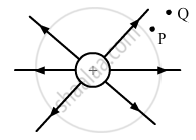
Figure shows the field lines due to a positive point charge. Give the sign of potential energy difference of a small negative charge between the points Q and P.
Concept: Potential Energy of a System of Charges
A circuit is set up by connecting inductance L = 100 mH, resistor R = 100 Ω and a capacitor of reactance 200 Ω in series. An alternating emf of \[150\sqrt{2}\] V, 500/π Hz is applies across this series combination. Calculate the power dissipated in the resistor.
Concept: Combination of Capacitors
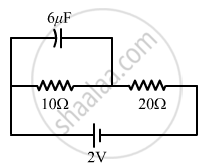
Find the charge on the capacitor as shown in the circuit.
Concept: Energy Stored in a Charged Capacitor
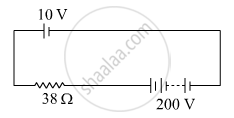
A 10 V battery of negligible internal resistance is connected across a 200 V battery and a resistance of 38Ω as shown in the figure. Find the value of the current in circuit.
Concept: Effect of Dielectric on Capacity
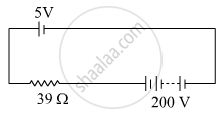
A 5 V battery of negligible internal resistance is connected across a 200 V battery and a resistance of 39Ω as shown in the figure. Find the value of the current in circuit.
Concept: Effect of Dielectric on Capacity
A capacitor of unknown capacitance is connected across a battery of V volts. The charge stored in it is 300 μC. When potential across the capacitor is reduced by 100 V, the charge stored in it becomes 100 μC. Calculate The potential V and the unknown capacitance. What will be the charge stored in the capacitor if the voltage applied had increased by 100 V?
Concept: Capacitors and Capacitance
Draw a plot of potential energy between a pair of nucleons as a function of their separation. Mark the regions where potential energy is (i) positive and (ii) negative.
Concept: Conductors and Insulators Related to Electric Field
A slab of material of dielectric constant K has the same area as that of the plates of a parallel plate capacitor but has the thickness d/2, where d is the separation between the plates. Find out the expression for its capacitance when the slab is inserted between the plates of the capacitor.
Concept: The Parallel Plate Capacitor
A slab of material of dielectric constant K has the same area as that of the plates of a parallel plate capacitor but has the thickness d/3, where d is the separation between the plates. Find out the expression for its capacitance when the slab is inserted between the plates of the capacitor.
Concept: The Parallel Plate Capacitor
A slab of material of dielectric constant K has the same area as that of the plates of a parallel plate capacitor but has the thickness 2d/3, where d is the separation between the plates. Find out the expression for its capacitance when the slab is inserted between the plates of the capacitor.
Concept: The Parallel Plate Capacitor
Why should electrostatic field be zero inside a conductor?
Concept: Conductors and Insulators Related to Electric Field
Why must electrostatic field be normal to the surface at every point of a charged conductor?
Concept: Electrical Potential Energy of a System of Two Point Charges and of Electric Dipole in an Electrostatic Field
Why is electrostatic potential constant throughout the volume of the conductor and has the same value (as inside) on its surface?
Concept: Relation Between Electric Field and Electrostatic Potential
A capacitor of 200 pF is charged by a 300 V battery. The battery is then disconnected and the charge capacitor is connected to another uncharged capacitor of 100 pF. Calculate the difference between the final energy stored in the combined system and the initial energy stored in the single capacitor.
Concept: Potential Energy in an External Field >> Potential Energy of a Single Charge
Why is there no work done in moving a charge from one point to another on an equipotential surface?
Concept: Equipotential Surfaces
A hollow metal sphere of radius 10 cm is charged such that the potential on its surface is 5 V. What is the potential at the centre of the sphere?
Concept: Relation Between Electric Field and Electrostatic Potential
Net capacitance of three identical capacitors in series is 2 μF. What will be their net capacitance if connected in parallel?
Concept: Capacitance of a Parallel Plate Capacitor with and Without Dielectric Medium Between the Plates
Find the ratio of energy stored in the two configurations if they are both connected to the same source.
Concept: Energy Stored in a Charged Capacitor
A parallel plate capacitor is being charged by a time varying current. Explain briefly how Ampere’s circuital law is generalized to incorporate the effect due to the displacement current ?
Concept: Capacitance of a Parallel Plate Capacitor with and Without Dielectric Medium Between the Plates
