Advertisements
Advertisements
Question
Three point charges +q each are kept at the vertices of an equilateral triangle of side 'l'. Determine the magnitude and sign of the charge to be kept at its centroid so that the charges at the vertices remain in equilibrium.
Advertisements
Solution
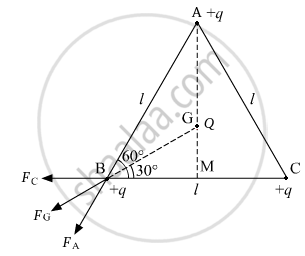
Let the charge at the centroid of the triangle ABC be Q.
The system will be in equilibrium if the net force on all the charges is zero.
In the given equilateral triangle ABC of sides of length l, if we draw a perpendicular AM to the side BC, then we get
\[AM = ACcos {30}^o = \frac{\sqrt{3}}{2}l\]
\[AG = \frac{2}{3}AD = \frac{1}{\sqrt{3}}l\]
By symmetry, AG = BG = CG.
Also, the net force on charge Q is zero.
Now, let us calculate the force on the charge placed at vertex B.
\[\vec{F}_{net} = \vec{F}_C + \vec{F}_A + \vec{F}_G \]
\[ \vec{F}_C =\frac{q^2}{4\pi \epsilon_0 l^2}\left( - \vec{i} \right) . . . . . \left( i \right)\]
\[ \vec{F}_A = \frac{q^2}{4\pi \epsilon_0 l^2}\left( \left( - \cos {60}^o \right) \vec {i}+ \left( - \sin {60}^o \right) \vec{j} \right) . . . . . \left( ii \right)\]
\[ \vec{F}_G = \frac{qQ}{4\pi\epsilon_0 \left( \frac{l}{\sqrt{3}} \right)^2} \left( \left( - \cos {30}^o \right)\vec{i} + \left( - \sin {30}^o \right) \vec{j} \right) . . . . . \left( iii \right)\]
\[\text { Adding }\left( i \right), \left( ii \right) \text { and } \left( iii \right), \text { we get }\]
\[ \vec{F}_{net} = \frac{q}{4\pi \epsilon_0 l^2}\left[ \left( - q - \frac{q}{2} - \frac{3\sqrt{3}Q}{2} \right) \vec{i} + \left( - \frac{\sqrt{3}q}{2} - \frac{3Q}{2} \right) \vec{j} \right]\]
\[\text { For equilibrium, net} = 0 . \]
\[\text { So }, \]
\[\left( - q - \frac{q}{2} - \frac{3\sqrt{3}Q}{2} \right) = 0 \text { and } \left( - \frac{\sqrt{3}q}{2} - \frac{3Q}{2} \right) = 0\]
\[ \Rightarrow Q = - \frac{q}{\sqrt{3}}\]
APPEARS IN
RELATED QUESTIONS
In a hydrogen atom, the electron and proton are bound at a distance of about 0.53 Å:
(a) Estimate the potential energy of the system in eV, taking the zero of the potential energy at infinite separation of the electron from proton.
(b) What is the minimum work required to free the electron, given that its kinetic energy in the orbit is half the magnitude of potential energy obtained in (a)?
(c) What are the answers to (a) and (b) above if the zero of potential energy is taken at 1.06 Å separation?
What is the work done by the field of a nucleus in a complete circular orbit of the electron? What if the orbit is elliptical?
Two-point charges placed in a medium of dielectric constant 5 are at a distance r between them, experience an electrostatic force ‘F’. The electrostatic force between them in vacuum at the same distance r will be ____________.
Three point charges +2, +2, and +5µC are placed respectively at the vertices A, B, C of an equilateral triangle of side 0.2 m. The magnitude of the force experienced by the charge at C is ______.
A work of 100 joule is performed in carrying a charge of 5 coulomb form infinity to a particular. point in an' electrostatic field. The potential of this point is:-
Potential energy of two equal negative point charges 2µc each held lm apart in air is:-
When one electron is taken towards the other electron, then the electric potential energy of the system ______
In a region of constant potential ______.
- the electric field is uniform
- the electric field is zero
- there can be no charge inside the region
- the electric field shall necessarily change if a charge is placed outside the region
A point charge q0 is moving along a circular path of radius a, with a point charge Q at the centre of the circle. The kinetic energy of q0 is ______.
