हिंदी

Three Point Charges +Q Each Are Kept at the Vertices of an Equilateral Triangle of Side 'L'. Determine the Magnitude and Sign of the Charge to Be Kept at Its Centroid So that the Charges - Physics

Advertisements
Advertisements

प्रश्न

Three point charges +q each are kept at the vertices of an equilateral triangle of side 'l'. Determine the magnitude and sign of the charge to be kept at its centroid so that the charges at the vertices remain in equilibrium.

Advertisements

उत्तर
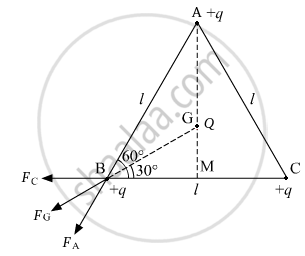
Let the charge at the centroid of the triangle ABC be Q.
The system will be in equilibrium if the net force on all the charges is zero.
In the given equilateral triangle ABC of sides of length l, if we draw a perpendicular AM to the side BC, then we get

\[AM = ACcos {30}^o = \frac{\sqrt{3}}{2}l\]

\[AG = \frac{2}{3}AD = \frac{1}{\sqrt{3}}l\]

By symmetry, AG = BG = CG.
Also, the net force on charge Q is zero.
Now, let us calculate the force on the charge placed at vertex B.

\[\vec{F}_{net} = \vec{F}_C + \vec{F}_A + \vec{F}_G \]

\[ \vec{F}_C =\frac{q^2}{4\pi \epsilon_0 l^2}\left( - \vec{i} \right) . . . . . \left( i \right)\]

\[ \vec{F}_A = \frac{q^2}{4\pi \epsilon_0 l^2}\left( \left( - \cos {60}^o \right) \vec {i}+ \left( - \sin {60}^o \right) \vec{j} \right) . . . . . \left( ii \right)\]

\[ \vec{F}_G = \frac{qQ}{4\pi\epsilon_0 \left( \frac{l}{\sqrt{3}} \right)^2} \left( \left( - \cos {30}^o \right)\vec{i} + \left( - \sin {30}^o \right) \vec{j} \right) . . . . . \left( iii \right)\]

\[\text { Adding }\left( i \right), \left( ii \right) \text { and } \left( iii \right), \text { we get }\]

\[ \vec{F}_{net} = \frac{q}{4\pi \epsilon_0 l^2}\left[ \left( - q - \frac{q}{2} - \frac{3\sqrt{3}Q}{2} \right) \vec{i} + \left( - \frac{\sqrt{3}q}{2} - \frac{3Q}{2} \right) \vec{j} \right]\]

\[\text { For equilibrium, net} = 0 . \]

\[\text { So }, \]

\[\left( - q - \frac{q}{2} - \frac{3\sqrt{3}Q}{2} \right) = 0 \text { and } \left( - \frac{\sqrt{3}q}{2} - \frac{3Q}{2} \right) = 0\]

\[ \Rightarrow Q = - \frac{q}{\sqrt{3}}\]

shaalaa.com
  क्या इस प्रश्न या उत्तर में कोई त्रुटि है?
2014-2015 (March) Foreign Set 2

वीडियो ट्यूटोरियलVIEW ALL [1]

संबंधित प्रश्न

In a hydrogen atom, the electron and proton are bound at a distance of about 0.53 Å:

(a) Estimate the potential energy of the system in eV, taking the zero of the potential energy at infinite separation of the electron from proton.

(b) What is the minimum work required to free the electron, given that its kinetic energy in the orbit is half the magnitude of potential energy obtained in (a)?

(c) What are the answers to (a) and (b) above if the zero of potential energy is taken at 1.06 Å separation?


We know that electric field is discontinuous across the surface of a charged conductor. Is electric potential also discontinuous there?


Guess a possible reason why water has a much greater dielectric constant (= 80) than say, mica (= 6).


The electrostatic potential energy of two-point charges, 1 µC each, placed 1 meter apart in the air is: 


In a region of constant potential ______.

The potential energy of a system of two charges is negative when ______.

If stretch in a spring of force constant k is tripled then the ratio of elastic potential energy in the two cases will be:


A work of 100 joule is performed in carrying a charge of 5 coulomb form infinity to a particular. point in an' electrostatic field. The potential of this point is:-


Potential energy of two equal negative point charges 2µc each held lm apart in air is:-


Three-point charges Q, q and -q are kept at the vertices of an equilateral triangle of side L as shown in the figure. What is 

  1. the electrostatic potential energy of the arrangement? and
  2. the potential at point D?

Share
Notifications

Englishहिंदीमराठी


      Forgot password?
Use app×