Advertisements
Advertisements
प्रश्न
Three point charges +q each are kept at the vertices of an equilateral triangle of side 'l'. Determine the magnitude and sign of the charge to be kept at its centroid so that the charges at the vertices remain in equilibrium.
Advertisements
उत्तर
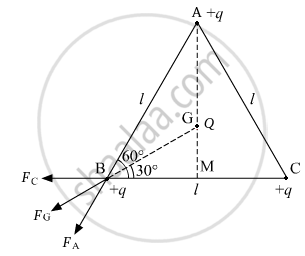
Let the charge at the centroid of the triangle ABC be Q.
The system will be in equilibrium if the net force on all the charges is zero.
In the given equilateral triangle ABC of sides of length l, if we draw a perpendicular AM to the side BC, then we get
\[AM = ACcos {30}^o = \frac{\sqrt{3}}{2}l\]
\[AG = \frac{2}{3}AD = \frac{1}{\sqrt{3}}l\]
By symmetry, AG = BG = CG.
Also, the net force on charge Q is zero.
Now, let us calculate the force on the charge placed at vertex B.
\[\vec{F}_{net} = \vec{F}_C + \vec{F}_A + \vec{F}_G \]
\[ \vec{F}_C =\frac{q^2}{4\pi \epsilon_0 l^2}\left( - \vec{i} \right) . . . . . \left( i \right)\]
\[ \vec{F}_A = \frac{q^2}{4\pi \epsilon_0 l^2}\left( \left( - \cos {60}^o \right) \vec {i}+ \left( - \sin {60}^o \right) \vec{j} \right) . . . . . \left( ii \right)\]
\[ \vec{F}_G = \frac{qQ}{4\pi\epsilon_0 \left( \frac{l}{\sqrt{3}} \right)^2} \left( \left( - \cos {30}^o \right)\vec{i} + \left( - \sin {30}^o \right) \vec{j} \right) . . . . . \left( iii \right)\]
\[\text { Adding }\left( i \right), \left( ii \right) \text { and } \left( iii \right), \text { we get }\]
\[ \vec{F}_{net} = \frac{q}{4\pi \epsilon_0 l^2}\left[ \left( - q - \frac{q}{2} - \frac{3\sqrt{3}Q}{2} \right) \vec{i} + \left( - \frac{\sqrt{3}q}{2} - \frac{3Q}{2} \right) \vec{j} \right]\]
\[\text { For equilibrium, net} = 0 . \]
\[\text { So }, \]
\[\left( - q - \frac{q}{2} - \frac{3\sqrt{3}Q}{2} \right) = 0 \text { and } \left( - \frac{\sqrt{3}q}{2} - \frac{3Q}{2} \right) = 0\]
\[ \Rightarrow Q = - \frac{q}{\sqrt{3}}\]
