मराठी

Four Charges +Q, −Q, +Q And −Q Are to Be Arranged Respectively at the Four Corners of a Square Abcd of Side 'A'. - Physics

Advertisements
Advertisements

प्रश्न

Four charges +q, −q, +q and −q are to be arranged respectively at the four corners of a square ABCD of side 'a'.
(a) Find the work required to put together this arrangement.
(b) A charge q0 is brought to the centre of the square, the four charges being held fixed. How much extra work is needed to do this ?

Advertisements

उत्तर
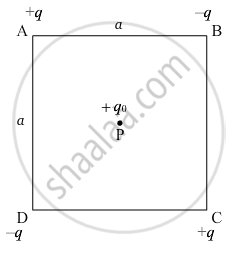
Here,
AB = BC = CD = DA = a
And,

\[AC = BD = a\sqrt{2}\]

Now,

\[\text{ Total work done} \left( W \right) = \text { Potential energy of the system of four charges } \]

\[W = \frac{\left( - q \right)\left( + q \right)}{4 \pi\epsilon_0 a} + \frac{\left( + q \right)\left( - q \right)}{4 \pi\epsilon_0 a} + \frac{\left( - q \right)\left( + q \right)}{4 \pi\epsilon_0 a} + \frac{\left( + q \right)\left( - q \right)}{4 \pi\epsilon_0 a} + \frac{1}{4 \pi\epsilon_0}\frac{\left( \left( - q \right)\left( - q \right) \right)}{a\sqrt{2}} + \frac{1}{4 \pi\epsilon_0}\frac{\left( \left( + q \right)\left( + q \right) \right)}{a\sqrt{2}}\]

\[ = \frac{- 4 q^2}{4 \pi\epsilon_0 a} + \frac{2 q^2}{4 \pi\epsilon_0 a\sqrt{2}} = \frac{- q^2}{4 \pi\epsilon_0 a}\left( 4 - \sqrt{2} \right)\]

\[\left( b \right)\]

\[\text { Extra work needed,} W_P = q_0 \times V_P \]

\[\text { Here,} \]

\[V_P \text{= Potential at point P }\]

\[\text { Now,} \]

\[\text { Potential at point P } = \frac{q}{4\pi \epsilon_0 \frac{a\sqrt{2}}{2}} + \frac{\left( - q \right)}{4\pi \epsilon_0 \frac{a\sqrt{2}}{2}} + \frac{q}{4\pi \epsilon_0 \frac{a\sqrt{2}}{2}} + \frac{\left( - q \right)}{4\pi \epsilon_0 \frac{a\sqrt{2}}{2}} = 0\]

\[ \Rightarrow W = 0\]

shaalaa.com
  या प्रश्नात किंवा उत्तरात काही त्रुटी आहे का?
2014-2015 (March) Foreign Set 2

व्हिडिओ ट्यूटोरियलVIEW ALL [3]

संबंधित प्रश्‍न

Three-point charges q, – 4q and 2q are placed at the vertices of an equilateral triangle ABC of side 'l' as shown in the figure. Obtain the expression for the magnitude of the resultant electric force acting on the charge q

(b) Find out the amount of the work done to separate the charges at infinite distance.


Plot a graph showing the variation of coulomb force (F) versus ,`(1/r^2)` where is the distance between the two charges of each pair of charges: (1 μC, 2 μC) and (2 μC, − 3 μC). Interpret the graphs obtained.


At what separation should two equal charges, 1.0 C each, be placed, so that the force between them equals the weight of a 50 kg person? 


Two small spheres, each with a mass of 20 g, are suspended from a common point by two insulating strings of length 40 cm each. The spheres are identically charged and the separation between the balls at equilibrium is found to be 4 cm. Find the charge on each sphere. 


A particle A with a charge of 2.0 × 10⁻⁶ C is held fixed on a horizontal table. A second charged particle of mass 80 g stays in equilibrium on the table at a distance of 10 cm from the first charge. The coefficient of friction between the table and this second particle is μ = 0.2. Find the range within which the charge of this second particle may lie.


What are the differences between the Coulomb force and the gravitational force?


The unit of charge is ______.


The value of electric permittivity of free space is ______.

Four equal charges q are placed at the four comers A, B, C, D of a square of length a. The magnitude of the force on the charge at B will be ______.


Electric charge of any system is ______.


Share
Notifications

Englishहिंदीमराठी


      Forgot password?
Use app×