Advertisements
Advertisements
प्रश्न
Four charges +q, −q, +q and −q are to be arranged respectively at the four corners of a square ABCD of side 'a'.
(a) Find the work required to put together this arrangement.
(b) A charge q0 is brought to the centre of the square, the four charges being held fixed. How much extra work is needed to do this ?
Advertisements
उत्तर
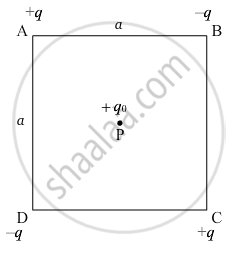
Here,
AB = BC = CD = DA = a
And,
\[AC = BD = a\sqrt{2}\]
Now,
\[\text{ Total work done} \left( W \right) = \text { Potential energy of the system of four charges } \]
\[W = \frac{\left( - q \right)\left( + q \right)}{4 \pi\epsilon_0 a} + \frac{\left( + q \right)\left( - q \right)}{4 \pi\epsilon_0 a} + \frac{\left( - q \right)\left( + q \right)}{4 \pi\epsilon_0 a} + \frac{\left( + q \right)\left( - q \right)}{4 \pi\epsilon_0 a} + \frac{1}{4 \pi\epsilon_0}\frac{\left( \left( - q \right)\left( - q \right) \right)}{a\sqrt{2}} + \frac{1}{4 \pi\epsilon_0}\frac{\left( \left( + q \right)\left( + q \right) \right)}{a\sqrt{2}}\]
\[ = \frac{- 4 q^2}{4 \pi\epsilon_0 a} + \frac{2 q^2}{4 \pi\epsilon_0 a\sqrt{2}} = \frac{- q^2}{4 \pi\epsilon_0 a}\left( 4 - \sqrt{2} \right)\]
\[\left( b \right)\]
\[\text { Extra work needed,} W_P = q_0 \times V_P \]
\[\text { Here,} \]
\[V_P \text{= Potential at point P }\]
\[\text { Now,} \]
\[\text { Potential at point P } = \frac{q}{4\pi \epsilon_0 \frac{a\sqrt{2}}{2}} + \frac{\left( - q \right)}{4\pi \epsilon_0 \frac{a\sqrt{2}}{2}} + \frac{q}{4\pi \epsilon_0 \frac{a\sqrt{2}}{2}} + \frac{\left( - q \right)}{4\pi \epsilon_0 \frac{a\sqrt{2}}{2}} = 0\]
\[ \Rightarrow W = 0\]
APPEARS IN
संबंधित प्रश्न
- Two insulated charged copper spheres A and B have their centers separated by a distance of 50 cm. What is the mutual force of electrostatic repulsion if the charge on each is 6.5 × 10⁻⁷ C? The radii of A and B are negligible compared to the distance of separation.
- What is the force of repulsion if each sphere is charged double the above amount, and the distance between them is halved?
Find the speed of the electron in the ground state of a hydrogen atom. The description of ground state is given in the previous problem.
Two charged particles with charge 2.0 × 10⁻⁸ C each are joined by an insulating string of length 1 m and the system is kept on a smooth horizontal table. Find the tension in the string.
Two identical pith balls are charged by rubbing one against the other. They are suspended from a horizontal rod through two strings of length 20 cm each, the separation between the suspension points being 5 cm. In equilibrium, the separation between the balls is 3 cm. Find the mass of each ball and the tension in the strings. The charge on each ball has a magnitude 2.0 × 10⁻⁸ C.
Two identical pith balls, each carrying a charge q, are suspended from a common point by two strings of equal length l. Find the mass of each ball if the angle between the strings is 2θ in equilibrium.
A particle A with a charge of 2.0 × 10⁻⁶ C and a mass of 100 g is placed at the bottom of a smooth inclined plane of inclination 30°. Where should another particle B, with the same charge and mass, be placed on the incline so that it may remain in equilibrium?
Two particles A and B, each carrying a charge Q, are held fixed with a separation dbetween them. A particle C of mass m and charge q is kept at the middle point of the line AB. Assuming x<<d, show that this force is proportional to x.
Four equal charges q are placed at the four comers A, B, C, D of a square of length a. The magnitude of the force on the charge at B will be ______.

Two point charges Q each are placed at a distance d apart. A third point charge q is placed at a distance x from the mid-point on the perpendicular bisector. The value of x at which charge q will experience the maximum Coulomb's force is ______.
The ratio of the forces between two charges placed at a certain distance apart in the air and by the same distance apart in a medium of dielectric constant K is ______.
