हिंदी

An Electron Moving Horizontally with a Velocity of 4 ✕ 104 M/S Enters a Region of Uniform Magnetic Field of 10−5 T Acting Vertically Upward as Shown in the Figure. Draw Its - Physics

Advertisements
Advertisements

प्रश्न

An electron moving horizontally with a velocity of 4 ✕ 104 m/s enters a region of uniform magnetic field of 10−5 T acting vertically upward as shown in the figure. Draw its trajectory and find out the time it takes to come out of the region of magnetic 
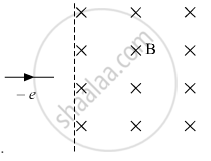
field.

Advertisements

उत्तर
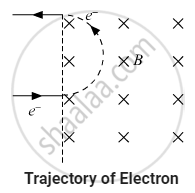
Let the time taken by the electron to come out of the region of magnetic field be t.
Velocity of the electron, v = 4 × 10⁴ m/s
Magnetic field, B = 10−5 T
Mass of the electron, m = 9 × 10⁻³¹ kg

We know

\[t = \frac{\pi r}{v}\]

\[\text { where r } = \frac{mv}{Bq}\]

\[\text { Now,} \]

\[t = \frac{\pi m}{Bq} = \frac{3 . 14 \times 9 \times {10}^{- 31}}{{10}^{- 5} \times 1 . 6 \times {10}^{- 19}}\]

\[ \Rightarrow t = 17 . 66 \times {10}^{- 7} s = 1 . 76 \mu s\]

Thus, the time taken by the electron to come out of the region of magnetic field is 1.76 μs.

shaalaa.com
Force on a Moving Charge in Uniform Magnetic and Electric Fields
  क्या इस प्रश्न या उत्तर में कोई त्रुटि है?
2014-2015 (March) Foreign Set 2

संबंधित प्रश्न

Write the expression for the force `vecF` acting on a particle of mass m and charge q moving with velocity `vecV` in a magnetic field `vecB` , Under what conditions will it move in (i) a circular path and (ii) a helical path?


A proton and a deuteron having equal momenta enter in a region of a uniform magnetic field at right angle to the direction of a the field. Depict their trajectories in the field.


A charged particle moves in a gravity-free space without change in velocity. Which of the following is/are possible?
(a) E = 0, B = 0
(b) E = 0, B ≠ 0
(c) E ≠ 0, B = 0
(d) E ≠ 0, B ≠ 0


Consider three quantities  \[x = E/B,   y = \sqrt{1/ \mu_0 \epsilon_0}\] and \[z = \frac{l}{CR}\] . Here, l is the length of a wire, C is a capacitance and R is a resistance. All other symbols have standard meanings.

(a) xy have the same dimensions.
(b) yz have the same dimensions.
(c) zx have the same dimensions.
(d) None of the three pairs have the same dimensions.


A current i is passed through a silver strip of width d and area of cross-section A. The number of free electrons per unit volume is n. (a) Find the drift velocity v of the electrons. (b) If a magnetic field B exists in the region, as shown in the figure, what is the average magnetic force on the free electrons? (c) Due to the magnetic force, the free electrons get accumulated on one side of the conductor along its length. This produces a transverse electric field in the conductor, which opposes the magnetic force on the electrons. Find the magnitude of the electric field which will stop further accumulation of electrons. (d) What will be the potential difference developed across the width of the conductor due to the electron-accumulation? The appearance of a transverse emf, when a current-carrying wire is placed in a magnetic field, is called Hall effect.


An electron of kinetic energy 100 eV circulates in a path of radius 10 cm in a magnetic field. Find the magnetic field and the number of revolutions per second made by the electron.


A narrow beam of singly charged potassium ions of kinetic energy 32 keV is injected into a region of width 1.00 cm with a magnetic field of strength 0.500 T, as shown in the figure. The ions are collected at a screen 95.5 cm away from the field region. If the beam contains isotopes of atomic weights 39 and 41, find the separation between the points where these isotopes strike the screen. Take the mass of a potassium ion = A (1.6 × 10⁻²⁷) kg, where A is the mass number.


A proton projected in a magnetic field of 0.020 T travels along a helical path of radius 5.0 cm and pitch 20 cm. Find the components of the velocity of the proton along and perpendicular to the magnetic field. Take the mass of the proton = 1.6 × 10⁻²⁷ kg


An electron is emitted with negligible speed from the negative plate of a parallel-plate capacitor charged to a potential difference V. The separation between the plates is dand a magnetic field B exists in the space, as shown in the figure. Show that the electron will fail to strike the upper plates if `d > ((2m_eV)/(eB_0^2))^(1/2)`


A particle of mass 10 mg and having a charge of 50 mC is projected with a speed of 15 m/s into a uniform magnetic field of 125 mT. Assuming that the particle is projected with its velocity perpendicular to the magnetic field, the time after which the particle reaches its original position for the first time is ______.


Share
Notifications

Englishहिंदीमराठी


      Forgot password?
Use app×