English

An Electron Moving Horizontally with a Velocity of 4 ✕ 104 M/S Enters a Region of Uniform Magnetic Field of 10−5 T Acting Vertically Upward as Shown in the Figure. Draw Its - Physics

Advertisements
Advertisements

Question

An electron moving horizontally with a velocity of 4 ✕ 104 m/s enters a region of uniform magnetic field of 10−5 T acting vertically upward as shown in the figure. Draw its trajectory and find out the time it takes to come out of the region of magnetic 
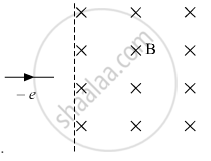
field.

Advertisements

Solution
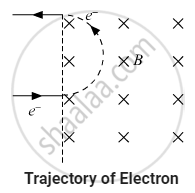
Let the time taken by the electron to come out of the region of magnetic field be t.
Velocity of the electron, v = 4 × 10⁴ m/s
Magnetic field, B = 10−5 T
Mass of the electron, m = 9 × 10⁻³¹ kg

We know

\[t = \frac{\pi r}{v}\]

\[\text { where r } = \frac{mv}{Bq}\]

\[\text { Now,} \]

\[t = \frac{\pi m}{Bq} = \frac{3 . 14 \times 9 \times {10}^{- 31}}{{10}^{- 5} \times 1 . 6 \times {10}^{- 19}}\]

\[ \Rightarrow t = 17 . 66 \times {10}^{- 7} s = 1 . 76 \mu s\]

Thus, the time taken by the electron to come out of the region of magnetic field is 1.76 μs.

shaalaa.com
Force on a Moving Charge in Uniform Magnetic and Electric Fields
  Is there an error in this question or solution?
2014-2015 (March) Foreign Set 2

RELATED QUESTIONS

Show that the kinetic energy of the particle moving in a magnetic field remains constant.


A long horizontal wire P carries a current of 50A. It is rigidly fixed. Another wire Q is placed directly above and parallel to P, as shown in Figure 1 below. The weight per unit length of the wire Q is 0.025 Nm-1 and it carries a current of 25A. Find the distance 'r' of the wire Q from the wire P so that the wire Q remains at rest


A charged particle moves in a uniform magnetic field. The velocity of the particle at some instant makes an acute angle with the magnetic field. The path of the particle will be


A particle is projected in a plane perpendicular to a uniform magnetic field. The area bounded by the path described by the particle is proportional to


A magnetic field of strength 1.0 T is produced by a strong electromagnet in a cylindrical region of radius 4.0 cm, as shown in the figure. A wire, carrying a  current of 2.0 A, is placed perpendicular to and intersecting the axis of the cylindrical region. Find the magnitude of the force acting on the wire.


A particle of charge 2.0 × 10⁻⁸ C and mass 2.0 × 10⁻¹⁰ g is projected with a speed of 2.0 × 10³ m s−1 in a region with a uniform magnetic field of 0.10 T. The velocity is perpendicular to the field. Find the radius of the circle formed by the particle and also the time period.


Doubly-ionised helium ions are projected with a speed of 10 km s−1 in a direction perpendicular to a uniform magnetic field of magnitude 1.0 T. Find (a) the force acting on an ion (b) the radius of the circle in which it circulates and (c) the time taken by an ion to complete the circle.


Two particles, each with mass m are placed at a separation d in a uniform magnetic field B, as shown in the figure. They have opposite charges of equal magnitude q. At time t = 0, the particles are projected towards each other, each with a speed v. Suppose the Coulomb force between the charges is switched off. (a) Find the maximum value vmof the projection speed, so that the two particles do not collide. (b) What would be the minimum and maximum separation between the particles if v = vm/2? (c) At what instant will a collision occur between the particles if v = 2vm? (d) Suppose v = 2vm and the collision between the particles is completely inelastic. Describe the motion after the collision.


A particle with a charge of 5.0 µC and a mass of 5.0 × 10⁻¹² kg is projected with a speed of 1.0 km s−1 in a magnetic field of magnitude 5.0 mT. The angle between the magnetic field and the velocity is sin−1 (0.90). Show that the path of the particle will be a helix. Find the diameter of the helix and its pitch.


A uniform magnetic field of 1.5 T exists in a cylindrical region of radius 10.0 cm, its direction parallel to the axis along east to west. A wire carrying current of 7.0 A in the north to south direction passes through this region. What is the magnitude and direction of the force on the wire if,

(a) the wire intersects the axis,

(b) the wire is turned from N-S to northeast-northwest direction,

(c) the wire in the N-S direction is lowered from the axis by a distance of 6.0 cm?


Share
Notifications

Englishहिंदीमराठी


      Forgot password?
Use app×