Please select a subject first
Advertisements
Advertisements
Write two devices based on the heating effect of electric current.
Concept: Heating Effect of Electric Current
It would cost a man Rs. 3.50 to buy 1.0 kW h of electrical energy from the Main Electricity Board. His generator has a maximum power of 2.0 kW. The generator produces energy at this maximum power for 3 hours. Calculate how much it would cost to buy the same amount of energy from the Main Electricity Board.
Concept: Heating Effect of Electric Current

Calculate the total resistance of the circuit and find the total current in the circuit.
Concept: Ohm's Law
A student boils water in an electric kettle for 20 minutes. Using the same mains supply he wants to reduce the boiling time of water. To do so should he increase or decrease the length of the heating element? Justify your answer.
Concept: Heating Effect of Electric Current

Plastic insulation surrounds a wire having diameter d and length l as shown above. A decrease in the resistance of the wire would be produced by an increase in the ______.
Concept: Factors of Resistance

The diagram above is a schematic diagram of a household circuit. The house shown in the above diagram has 5 usable spaces where electrical connections are made. For this house, the mains have a voltage of 220 V and the net current coming from the mains is 22A.
- What is the mode of connection to all the spaces in the house from the mains?
- The spaces 5 and 4 have the same resistance and spaces 3 and 2 have respective resistances of 20Ω and 30Ω. Space 1 has a resistance double that of space 5. What is the net resistance for space 5.
- What is the current in space 3?
- What should be placed between the main connection and the rest of the house’s electrical appliances to save them from accidental high electric current?
Concept: Resistance of a System of Resistors >> Resistors in Parallel
Two students decided to investigate the effect of water and air on iron object under identical experimental conditions. They measured the mass of each object before placing it partially immersed in 10 ml of water. After a few days, the object were removed, dried and their masses were measured. The table shows their results.
| Student | Object | Mass of Object before Rusting in g |
Mass of the coated object in g |
| A | Nail | 3.0 | 3.15 |
| B | Thin plate | 6.0 | 6.33 |
What might be the reason for the varied observations of the two students?
Concept: Heating Effect of Electric Current
In which of the following applications of Iron, rusting will occur most? Support your answer with valid reason.
| A | B | C | D |
 |
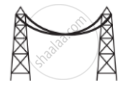 |
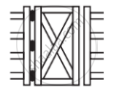 |
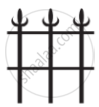 |
Concept: Heating Effect of Electric Current
In a set up the students coated iron nails with zinc metal and noted that, iron nails coated with zinc prevents rusting. They also observed that zinc initially acts as a physical barrier, but an extra advantage of using zinc is that it continues to prevent rusting even if the layer of zinc is damaged. Name this process of rust prevention and give any two other methods to prevent rusting.
Concept: Heating Effect of Electric Current
State Ohm's Law. Represent it mathematically.
Concept: Ohm's Law
What is the resistance of a conductor through which a current of 0.5 A flows when a potential difference of 2V is applied across its ends?
Concept: Ohm's Law
What is the heating effect of electric current?
Concept: Heating Effect of Electric Current
Write an expression for the amount of heat produced in a resistor when an electric current is passed through it stating the meanings of the symbols used.
Concept: Heating Effect of Electric Current
Three resistors of 6Ω, 4Ω and 4Ω are connected together so that the total resistance is 8Ω. Draw a diagram to show this arrangement and give reason to justify your answer.
Concept: Resistance of a System of Resistors >> Resistors in Parallel
How is electric current related to the potential difference across the terminals of a conductor?
Draw a labelled circuit diagram to verify this relationship.
Concept: Ohm's Law
Why should an ammeter have low resistance?
Concept: Ohm's Law
Two V-I graphs A and B for series and parallel combinations of two resistors are as shown. Giving reason state which graph shows (a) series, (b) parallel combination of the resistors.

Concept: Resistance of a System of Resistors >> Resistors in Parallel
A piece of wire of resistance R is cut into three equal parts. These parts are then connected in parallel. If the equivalent resistance of this parallel combination is R1, what is the value of the ratio R1 : R?
Concept: Resistance of a System of Resistors >> Resistors in Parallel
State the law that explains the heating effect of current with respect to the measurable properties in an electrical circuit.
Concept: Heating Effect of Electric Current
Anannya responded to the question: Why do electrical appliances with metallic bodies are connected to the mains through a three-pin plug, whereas an electric bulb can be connected with a two-pin plug?
She wrote: Three-pin connections reduce heating of connecting wires.
- Is her answer correct or incorrect? Justify.
- What is the function of a fuse in a domestic circuit?
Concept: Heating Effect of Electric Current
