Key Points
Key Points: Nomenclature of Aldehydes and Ketones
In IUPAC system in aldehyde the suffix ‘e’ of alkane is replaced by ‘al’, e.g.,
CH₃—CH₂—CH=O; Propanal
\[ \underset{\text{2-methylpropanal}}{\mathrm{CH}_3 - \underset{\underset{\displaystyle \mathrm{CH}_3}{|}}{\mathrm{CH}} - \mathrm{CH} = \mathrm{O}} \]
In ketones, the suffix ‘e’ of alkane is replaced by ‘one’.
For example,
\[ \underset{\text{Butan-2-one}}{\mathrm{CH}_3 - \mathrm{CH}_2 - \overset{\displaystyle \mathrm{O}}{\overset{||}{\mathrm{C}}} - \mathrm{CH}_3} \quad \quad \underset{\text{Propanone (Acetone)}}{\mathrm{CH}_3\mathrm{COCH}_3} \]
Key Points: Physical Properties of Aldehydes and Ketones
- Most aldehydes are liquids (except HCHO = gas); ketones of lower order are colourless liquids with a pleasant odour.
- Higher BP than corresponding hydrocarbons but lower than alcohols (no H-bonding between molecules, but dipole-dipole interactions).
- Lower members are soluble in water (H-bonding with water); higher members are insoluble (large alkyl groups).
Key Points: Chemical Reactions of Aldehydes and Ketones - Nucleophilic Addition Reactions
Addition of HCN:
\[\text{HCN} + \text{OH}^- \rightleftharpoons :\text{CN}^- + \text{H}_2\text{O}\]

Addition of NaHSO3:

Addition of Grignard reagent:

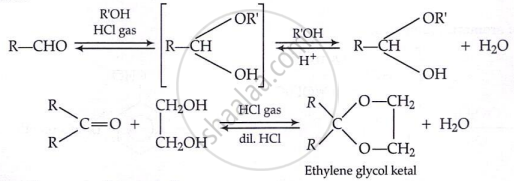
Addition of alcohols:
Key Points: Uses of Aldehydes and Ketones
- Formaldehyde: Used in making Bakelite (phenol-formaldehyde resin), as a preservative (formalin = 40% HCHO).
- Acetaldehyde: Used in the preparation of acetic acid and ethanol.
- Acetone: Solvent (nail polish remover), used in the manufacture of chloroform.
- Benzaldehyde: Used in perfumes and dyes.
Important Questions [31]
- Give Iupac Name
- How Are Ketones Classified?
- Write Two Uses of Formaldehyde
- Write the Structures and IUPAC Names of the α - Methyl Butyraldehyde.
- Write chemical reactions for the following conversions: Ethyl bromide to ethyl methyl ether.
- Compound Having General Formula
- Explain the Structure of Carbonyl Functional Group
- How Are the Following Compounds Prepared? Benzaldehyde from Benzoyl Chloride
- Acetaldehyde, when treated with which among the following reagents does NOT undergo addition reaction?
- Write balanced chemical equations for action of ammonia on - formaldehyde
- How Are the Following Compounds Prepared? benzaldehyde from benzene.
- Explain the Mechanism of Alkaline Hydrolysis of Tert-butyl Bromide with Energy Profile Diagram.
- What Are Amines?
- How will you convert sodium acetate to methane?
- How Will You Convert Benzoic Acid to M-bromobenzoic Acid?
- Write the name of product formed, when acetone is treated with 2, 4-dinitrophenyl hydrazine.
- What is the action of sodium hypoiodite on acetone?
- The product of following reaction is CHA3−CH=CH−CHA2−CHO→ii) HA3OA+i) LiAlHA4 ______?
- The product of the following reaction is O.........||.........CA2HA5−C−CHA3→ΔHA2/Ni..?
- How Are the Following Compounds Prepared? Acetophenone from Benzene
- Write Balanced Chemical Equations for Action of Ammonia on - Acetaldehyde
- Write Balanced Chemical Equations for Action of Ammonia on - Acetone
- What is the Action of the Following Reagents on Ethanoic Acid?
- Write the Structure of Phenylmethanamine.
- How is 4-methylpent-3en-2-one Obtained from Propan-2-one?
- Write Mechanism of Aldol Addition Reaction.
- Formalin is 40% Aqueous Solution of
- How Will You Convert Acetone to Acetone Cyanohydrin?
- Explain the following reaction: Cannizzaro reaction
- Write the chemical reaction involved in Cannizzaro reaction of methanal.
- Write a Note on Self Oxidation-reduction Reaction of Aldehyde with Suitable Example.
Concepts [7]
- Nomenclature of Aldehydes and Ketones
- Nature of Carbonyl Group
- Physical Properties of Aldehydes and Ketones
- Chemical Reactions of Aldehydes and Ketones - Nucleophilic Addition Reactions
- Reactivity of Alpha Hydrogen in Aldehydes
- Uses of Aldehydes and Ketones
- Chemical Reactions of Aldehydes and Ketones - Other Reactions
