Advertisements
Advertisements
Question
Write the mechanism of hydration of ethene to yield ethanol.
Advertisements
Solution 1
Step 1: Protonation of the alkene to form a carbocation by the electrophilic attack of H3O+.
\[\ce{H2O + H+ -> H3O+}\]

Step 2: Nucleophilic attack of water on carbocation.

Step 3: Deprotonation to form an alcohol.

Solution 2
The acid-catalysed hydration of ethene may be represented as:
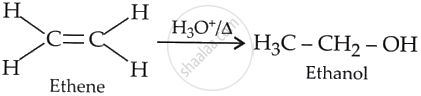
The mechanism followed by the above reaction may be depicted as:
Step 1: Generation of carbocation: Protonation of ethene yields a carbocation as,
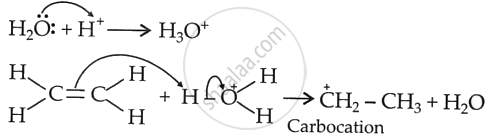
Step 2: Nucleophilic attack of water on carbocation: The carbocation polarises the lone pair electrons of O of water, and hydration takes place.

Step 3: Formation of product, regeneration of the proton:

APPEARS IN
RELATED QUESTIONS
Write the structures of the main products when acetone (CH3 − CO − CH3) reacts with the following reagents :
CH3MgBr and then H3O+
How is the following conversion carried out?
\[\ce{Propene -> Propan-2-ol}\]
How is the following conversion carried out?
\[\ce{Methyl magnesium bromide -> 2-Methylpropan-2-ol}\]
Name the reagent used in the following reaction:
Butan-2-one to butan-2-ol.
Show how you would synthesise the following alcohol from an appropriate alkene?

Name the reagents used in the following reactions:

Write the structure of main compounds A and B in the following reaction:
\[\ce{CH3CH2CN->[CH3MgBRH/3O+]A->[LiAIH4]B}\]
Aldehydes react with Grignard reagent to produce ____________.
Aldehydes are reduced to the corresponding alcohols by the addition of hydrogen in the presence of catalysts to form ____________.
Benzaldehyde differs from acetaldehyde in that:
Identify ‘C’ in the following:

The Wittig reaction is a reaction between a carbonyl compound (aldehyde or ketone only) and a species known as a phosphoniumylide. What is the expected final product in the Wittig reaction?
Select the acid(s) which cannot be prepared by Grignard reagent.
Glycerol is used in the manufacture
The major product of acid catalysed dehydration of 1-methylcyclohexanol is ______.
To synthesise 1.0 mole of 2-methylpropan-2-ol from Ethylethanoate ______ equivalents of CH3MgBr reagent will be required. (Integer value)


The products "A" and "B" formed in above reactions are:
The major product of the following reaction is:
\[\begin{array}{cc}
\ce{Cl}\phantom{.........................}\\
|\phantom{..........................}\\
\ce{CH3 - CH - CH3 ->[(i) Alc. KOH][(ii) HBr/peroxide (iii) aq. KOH]}
\end{array}\]
Ceric aminonium nitrate and CHCl3/alc. KOH are used for the identification of functional groups present in ______ and ______ respectively.
