Advertisements
Advertisements
Question

Advertisements
Solution 1
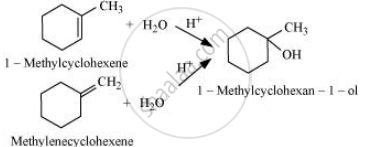
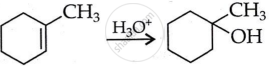
The given alcohols can be synthesised by applying Markovnikov’s rule of acid-catalysed hydration of appropriate alkenes.
Solution 2
APPEARS IN
RELATED QUESTIONS
Show how is the following alcohol prepared by the reaction of a suitable Grignard reagent on methanal?
\[\begin{array}{cc}
\ce{CH3 - CH - CH2OH}\\
|\phantom{........}\\
\ce{CH3}\phantom{....}\\
\end{array}\]
What is meant by hydroboration-oxidation reaction? Illustrate it with an example.
Write the mechanism of hydration of ethene to yield ethanol.
How is the following conversion carried out?
\[\ce{Benzyl chloride -> Benzyl alcohol}\]
How is the following conversion carried out?
\[\ce{Ethyl magnesium chloride -> Propan-1-ol}\]
Show how you would synthesise the following alcohol from an appropriate alkene?

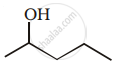
Show how you would synthesise the following alcohol from an appropriate alkene?
Name the reagents used in the following reactions:

Monochlorination of toluene in sunlight followed by hydrolysis by aq. \[\ce{NaOH}\] yields.
Benzaldehyde differs from acetaldehyde in that:
Commercially carboxylic acids are reduced to alcohols by converting them to the ______.
Magnesium wire continues to burn in the atmosphere of CO2 because
Most readily hydrolysed halide is:-
Glycerol is used in the manufacture
The best reagent to convert pent - 3 - en - 2 - ol into pent - 3 - en - 2 one is ______.
The major product of acid catalysed dehydration of 1-methylcyclohexanol is ______.
For distinction between \[\ce{CH3CHO}\] and \[\ce{C6H5CHO}\] the reagent used is ______.
How are the following conversion carried out?
\[\ce{Methyl magnesium bromide -> 2-Methylpropan-2-ol}\]
