Advertisements
Advertisements
Question
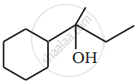
Show how you would synthesise the following alcohol from an appropriate alkene?
Advertisements
Solution 1
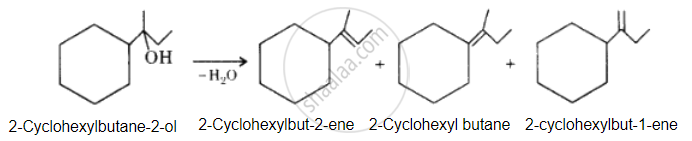
The desired alcohol is obtained from any of these alkenes by adding H2O in the presence of acid.
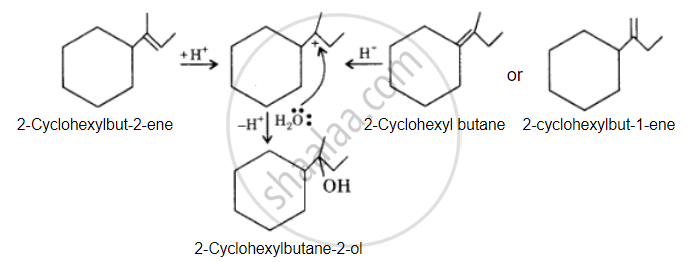
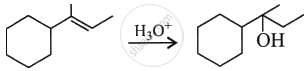
Solution 2
APPEARS IN
RELATED QUESTIONS
How will you convert: Propene to Propan-2-ol?
Write the main product(s) in each of the following reactions:

Name the reagents used in the following reactions:

How is the following conversion carried out?
\[\ce{Methyl magnesium bromide -> 2-Methylpropan-2-ol}\]
Name the reagent used in the following reaction:
Dehydration of propan-2-ol to propene.
Primary alcohols are prepared by the reduction of carboxylic acids. Though lithium aluminium hydride is a strong reducing agent, it is not used in the reaction. This is so because:
Monochlorination of toluene in sunlight followed by hydrolysis by aq. \[\ce{NaOH}\] yields.
Which of the following reacts with NaOH to give alcohol?
Acetone reacts with Grignard reagent to form:
Why is the reactivity of all the three classes of alcohols with conc. \[\ce{HCl}\] and \[\ce{ZnCl2}\] (Lucas reagent) different?
Explain a process in which a biocatalyst is used in industrial preparation of a compound known to you.
Select the acid(s) which cannot be prepared by Grignard reagent.
The reagent used for dehydration of an alcohol is
Glycerol as a trimester present in
The major product of acid catalysed dehydration of 1-methylcyclohexanol is ______.


The products "A" and "B" formed in above reactions are:
\[\ce{C3H8O ->[{[O]}][K2Cr2O7/H2SO4] C3H6O ->[I2 + NaOH(aq.)] CHI3}\]
In this reaction the first compound is:
For distinction between \[\ce{CH3CHO}\] and \[\ce{C6H5CHO}\] the reagent used is ______.
\[\ce{? ->[\Delta, CN-][EtOH, H2O]}\] Benzoin.
The reactant is obtained by dry distillation of the calcium salts of the following pairs:
The major product of the following reaction is:
\[\begin{array}{cc}
\ce{Cl}\phantom{.........................}\\
|\phantom{..........................}\\
\ce{CH3 - CH - CH3 ->[(i) Alc. KOH][(ii) HBr/peroxide (iii) aq. KOH]}
\end{array}\]
