Advertisements
Advertisements
Question
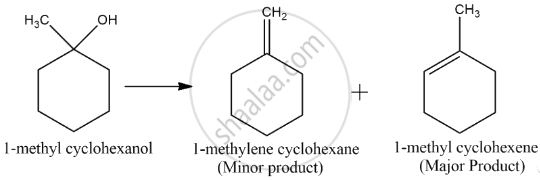
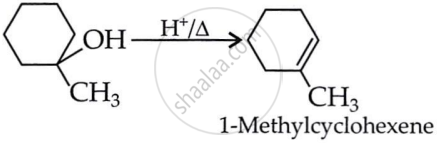
Predict the major product of acid catalysed dehydration of 1-methylcyclohexanol.
Advertisements
Solution 1
Acid catalyzed dehydration of 1-methylcyclohexanol can give two products, I and II. Since product (I) is more highly substituted, it is the major product according to the Setzeff rule.
Solution 2
APPEARS IN
RELATED QUESTIONS
How do you convert the following : Propan-2-ol to 2-methylpropan-2-ol
Show how is the following alcohol prepared by the reaction of a suitable Grignard reagent on methanal?

What is meant by hydroboration-oxidation reaction? Illustrate it with an example.
How is the following conversion carried out?
\[\ce{Benzyl chloride -> Benzyl alcohol}\]
How is the following conversion carried out?
\[\ce{Ethyl magnesium chloride -> Propan-1-ol}\]

Show how you would synthesise the following alcohol from an appropriate alkene?

How will you convert: Phenol to 2, 4, 6 − trinitrophenol?
Write the structures of A, B and C in the following reactions :
Write the structure of main compounds A and B in the following reaction:
\[\ce{CH3CH2CN->[CH3MgBRH/3O+]A->[LiAIH4]B}\]
Aldehydes are reduced to the corresponding alcohols by the addition of hydrogen in the presence of catalysts to form ____________.
Identify ‘C’ in the following:

The reagent used for dehydration of an alcohol is
The best reagent to convert pent 3 – en 2 – 01 into pent 3 – in – 2 – one is
When alcohol react with concentrated H2SO4 intermediate compound formed is
The best reagent to convert pent - 3 - en - 2 - ol into pent - 3 - en - 2 one is ______.
An aldehyde isomeric with allyl alcohol gives phenyl hydrazone. Pick out a ketone that too gives a phenyl hydrazone containing the same percentage of nitrogen.
\[\ce{C3H8O ->[{[O]}][K2Cr2O7/H2SO4] C3H6O ->[I2 + NaOH(aq.)] CHI3}\]
In this reaction the first compound is:
