Advertisements
Advertisements
प्रश्न

Advertisements
उत्तर १
The given alcohols can be synthesised by applying Markovnikov’s rule of acid-catalysed hydration of appropriate alkenes.
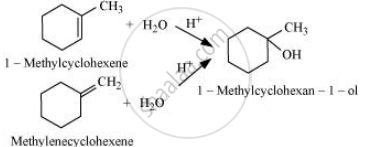
उत्तर २
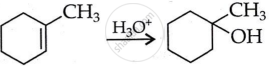
APPEARS IN
संबंधित प्रश्न
Predict the major product of acid catalysed dehydration of 1-methylcyclohexanol.
Show how will you synthesize 1-phenylethanol from a suitable alkene.
How is the following conversion carried out?
\[\ce{Benzyl chloride -> Benzyl alcohol}\]
How is the following conversion carried out?
\[\ce{Ethyl magnesium chloride -> Propan-1-ol}\]
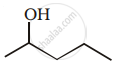
Show how you would synthesise the following alcohol from an appropriate alkene?
Ketones react with Grignard reagent to produce ____________.
Benzaldehyde differs from acetaldehyde in that:
Commercially carboxylic acids are reduced to alcohols by converting them to the ______.
Acetone reacts with Grignard reagent to form:
How can propan-2-one be converted into tert- butyl alcohol?
Explain a process in which a biocatalyst is used in industrial preparation of a compound known to you.
Magnesium wire continues to burn in the atmosphere of CO2 because
An aldehyde isomeric with allyl alcohol gives phenyl hydrazone. Pick out a ketone that too gives a phenyl hydrazone containing the same percentage of nitrogen.
\[\ce{C3H8O ->[{[O]}][K2Cr2O7/H2SO4] C3H6O ->[I2 + NaOH(aq.)] CHI3}\]
In this reaction the first compound is:
The major product of the following reaction is:
\[\begin{array}{cc}
\ce{Cl}\phantom{.........................}\\
|\phantom{..........................}\\
\ce{CH3 - CH - CH3 ->[(i) Alc. KOH][(ii) HBr/peroxide (iii) aq. KOH]}
\end{array}\]
Given below are two statements:
Statement I: On heating with KHSO4, glycerol is dehydrated and acrolein is formed.
Statement II: Acrolein has a fruity odour and can be used to test glycerol's presence.
Choose the correct option.
Ceric aminonium nitrate and CHCl3/alc. KOH are used for the identification of functional groups present in ______ and ______ respectively.
How are the following conversion carried out?
\[\ce{Methyl magnesium bromide -> 2-Methylpropan-2-ol}\]
