Advertisements
Advertisements
प्रश्न
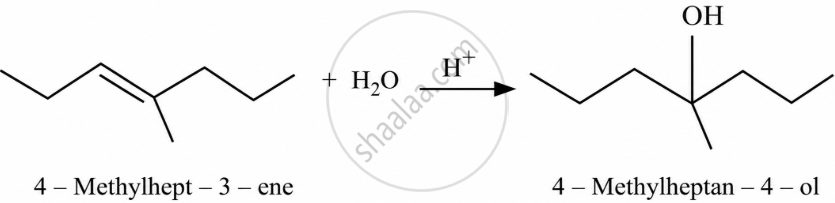
Show how you would synthesise the following alcohol from an appropriate alkene?

Advertisements
उत्तर
The given alcohols can be synthesised by applying Markovnikov’s rule of acid-catalysed hydration of appropriate alkenes.
APPEARS IN
संबंधित प्रश्न
Write the structures of the main products when acetone (CH3 − CO − CH3) reacts with the following reagents :
CH3MgBr and then H3O+
Show how is the following alcohol prepared by the reaction of a suitable Grignard reagent on methanal?
\[\begin{array}{cc}
\ce{CH3 - CH - CH2OH}\\
|\phantom{........}\\
\ce{CH3}\phantom{....}\\
\end{array}\]
Predict the major product of acid catalysed dehydration of 1-methylcyclohexanol.
How is the following conversion carried out?
\[\ce{Ethyl magnesium chloride -> Propan-1-ol}\]
Name the reagent used in the following reaction:
Butan-2-one to butan-2-ol.
How will you convert: Phenol to 2, 4, 6 − trinitrophenol?
Name the reagents used in the following reactions:

Benzaldehyde differs from acetaldehyde in that:
How can propan-2-one be converted into tert- butyl alcohol?
Explain a process in which a biocatalyst is used in industrial preparation of a compound known to you.
A compound does not react with 2, 4 dinitrophenylhydrazine, the compound is:
The best reagent to convert pent 3 – en 2 – 01 into pent 3 – in – 2 – one is
Glycerol as a trimester present in
Alkaline hydrolysis of an alkyl halide can be preferably carried out using ______.
The best reagent to convert pent - 3 - en - 2 - ol into pent - 3 - en - 2 one is ______.


The products "A" and "B" formed in above reactions are:
An aldehyde isomeric with allyl alcohol gives phenyl hydrazone. Pick out a ketone that too gives a phenyl hydrazone containing the same percentage of nitrogen.
Write the mechanism of acid dehydration of ethanol to yield ethene.
How are the following conversions carried out?
\[\ce{Methyl magnesium bromide ->2-Methylpropan-2-ol}\]
