Advertisements
Advertisements
प्रश्न
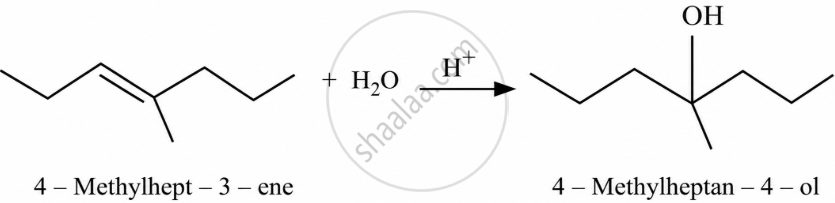
Show how you would synthesise the following alcohol from an appropriate alkene?

Advertisements
उत्तर
The given alcohols can be synthesised by applying Markovnikov’s rule of acid-catalysed hydration of appropriate alkenes.
APPEARS IN
संबंधित प्रश्न
What is meant by hydroboration-oxidation reaction? Illustrate it with an example.
Write the mechanism of hydration of ethene to yield ethanol.

How will you convert: Phenol to 2, 4, 6 − trinitrophenol?
Aldehydes react with Grignard reagent to produce ____________.
The Wittig reaction is a reaction between a carbonyl compound (aldehyde or ketone only) and a species known as a phosphoniumylide. What is the expected final product in the Wittig reaction?
Magnesium wire continues to burn in the atmosphere of CO2 because
Carboxylic acids are more acidic than phenol and alcohol because of
A compound does not react with 2, 4 dinitrophenylhydrazine, the compound is:
The best reagent to convert pent 3 – en 2 – 01 into pent 3 – in – 2 – one is
Glycerol is used in the manufacture
Glycerol as a trimester present in
When glycol is heated with dicorboxylic acid the product are
The best reagent to convert pent - 3 - en - 2 - ol into pent - 3 - en - 2 one is ______.
The major product of acid catalysed dehydration of 1-methylcyclohexanol is ______.
For distinction between \[\ce{CH3CHO}\] and \[\ce{C6H5CHO}\] the reagent used is ______.
The major product of the following reaction is:
\[\begin{array}{cc}
\ce{Cl}\phantom{.........................}\\
|\phantom{..........................}\\
\ce{CH3 - CH - CH3 ->[(i) Alc. KOH][(ii) HBr/peroxide (iii) aq. KOH]}
\end{array}\]
Given below are two statements:
Statement I: On heating with KHSO4, glycerol is dehydrated and acrolein is formed.
Statement II: Acrolein has a fruity odour and can be used to test glycerol's presence.
Choose the correct option.
